By Marisa Gray Atha
He’d been asking for someone to clip his hair. After the second round of chemo, the one that robbed Dad of his signature swatch of thick hair, had come and gone, he’d been left nearly bald, with some straggly white strands speckled randomly around his scalp stubbornly holding their footing. These homesteaders continued to grow in length, retracting into wiry curls before a soft batch of light-gray peach fuzz began to grow, a solid patch of downy moss on the stony wasteland of his head. His nails had grown long as well, easily scratching at his itchy, dry scalp.
Once a man of fastidious care for his own health and personhood, who regularly flossed, who kept his golf shoes scrubbed clean from mud, who tucked in his collared shirt, who painted his rental properties with a wet rag slung into his overalls to quickly dash away an extra spot or splash, a man who reorganized his and his children’s and his grandchildren’s ski gear every summer, primed and ready for the season well in advance, this now was a man who lived from meal to meal, from pill to pill, who leaned on others to walk from the front of the house to the rear of the house to use the restroom, who relied on the good intentions of others to schedule his doctor appointments, to cook his meals, to wake him for the next dose.
Ten days before he died, I’d come to visit. He wore his gray sweatpants and long-sleeve shirt as usual, sat in his recliner as usual, scratched his head as usual. At dinner the prior evening, he’d once again been asking someone to clip his hair. He looked to my husband, my brother, even me—could anyone do it? They searched for his electric clippers in the garage, the ones they’d spontaneously shaved his head with a few years earlier on a family vacation to Tahoe; we all laughed at the memory of Dad transforming from the shaggy, wavy mop to closely shorn and trimmed. But the clippers weren’t found and once again, he settled dejectedly into absentmindedly rummaging fingers through the stray strands, rubbing along the peach fuzz.
On my Monday morning visit, I asked for a small set of nail scissors. Mom and I walked Dad to the family room table and pulled out a chair for him to sit. We draped a towel around his shoulders, and I slowly began cutting. Gently feeling along his scalp, I lifted each individual hair, or perhaps a few nearby strands as well, tugging them upwards and then snipping them to the length of the peach fuzz growing in, about a quarter inch above his scalp.
“Does this feel okay?” I asked.
“Yes,” he softly answered.
“It doesn’t hurt? I’m not pulling too much?”
He didn’t reply for a moment. His eyes closed. “No,” he finally replied, keeping his eyes closed. “It feels good.”
“Okay,” I said, and continued gathering, gently tugging, trimming.
My hands carefully roamed his scalp, catching each individual wiry stalk that had clung on through the cocktail of chemicals that had wrecked the rest of his body, of course, excepting the cancer that chugged along, consuming and multiplying as ever.
Finally, I said, “I’m finished.”
He opened his eyes and rubbed his hand along his head. Having done the same for the last thirty minutes, my fingertips could still sense the closely knit crop of hair, so buoyantly firm and tenderly soft.
Dad looked up into my eyes, his sunken cheeks pale against the blue tinge of undereye circles, and said, “Thank you.”
“You’re welcome,” I replied, feeling heat rising to my cheeks and resisting the sting that threatened to creep into my eyes. “Can I trim your nails?”
“No, no, maybe another time,” he said, fanning out his fingers and surveying the claws he’d been growing.
“Are you sure? It will just take a minute,” I tried again.
I turned to my mother, “Mom, can you find his nail clippers?”
It was now or never, I decided, suddenly feeling urgency.
He sighed, and resigned himself, “Alright.” By now, he was used to people regularly making these small decisions for him, regardless of his comfort level or fatigue. He was accustomed to performing up to our standards, almost always while feeling miserable.
But cutting his nails seemed the next necessary thing to do.
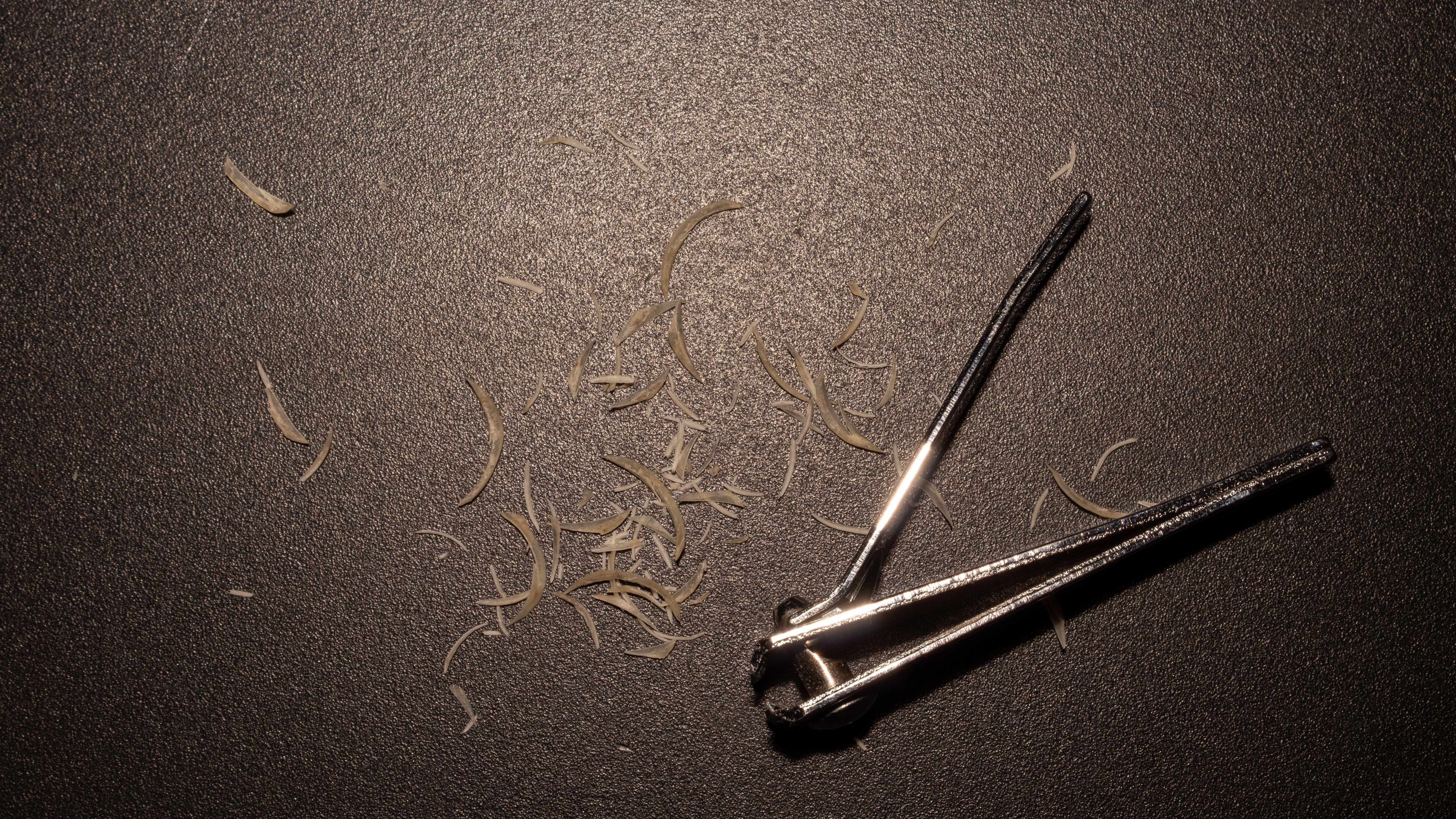
This time, we set him up on the patio, on an outdoor chair. Mom thankfully found the nail clippers swiftly. As I brought his nail between the metal clamps, I considered the size. I’d been trimming my three daughters’ nails since they were babies—almost nine years of trimming other humans’ nails. I thought of the desperate carefulness while trimming an infant’s nails, the paranoia of nipping a bit of skin, then the wrestle of trimming a toddler’s nails, bargaining with them to hold still just enough to get each snip in and, now, the greater ease of trimming my school-age children’s nails, the asking and accepting of the process that now seemed so easy in comparison to where we’d begun.
This will be easy, I thought. But as I pressed on the clippers to close and snip, the nail bent but didn’t offer the pleasant snap I was expecting to hear. I tried again, this time adding considerable pressure. It worked. The nail gave, and I inched around to trim the other side of it.
“Ow,” he said, wincing.
“Sorry—the clippers are dull, I think,” I said, lamely. I forged on, knowing that with each clip, I had to apply more force than should be necessary, and with each clip, I was creating discomfort. But it was now or never. “Almost done,” I said, holding the last nail in place, after too many dulled snips. “Okay, done.” I sat back and felt equally satisfied and guilty at my handiwork. His hair and nails were neatly trimmed, a semblance of health and civility amidst the brutality of our recent months. But I’d hurt and wearied him, and for that, I felt wretched.
“It’s so nice out here in the sun,” Mom said to him. “Would you like to sit out here a bit longer and soak up some vitamin D?” We’d read about the cancer-fighting benefits of vitamin D.
“No,” he answered, crankily. “I’m tired. I want to go in.”
“Okay,” Mom and I both replied together, offering our arms to help him stand.
“I guess I’d better go,” I said, when we’d walked him back to his recliner. Where I was going, I can’t recall now—perhaps to pick up my youngest from preschool.
“Thank you,” Dad said, looking at me. “I feel better.” He rubbed a hand along his head, looking satisfied with the feel of it.
“You’re welcome,” I said, kissing him on the cheek as I always did before leaving. “Love you.”
“Love you,” he said, and I turned to go.
Over the course of the ten days to come, as he settled into his liver failure, his hospice care, his hospital bed set up in the same spot where I’d trimmed his hair, I was glad that I’d offered him the dignity of his grooming. I was satisfied with the result of the haircut while regretting the dullness of the nail clippers but, nonetheless, we were both glad that these trimmings had been performed. He seemed to enjoy his uniform-length hair and shortened nails, both semblances of health and normalcy.
By the weekend, he needed help even to stand for a moment. He could no longer walk to the back of the house to use the restroom and resigned himself to the commode the hospice care had provided for his convenience. I offered to help through any and all of it—I would bring him to the commode. I would help clean and change him; but he wanted none of it.
The head hospice nurse, Diana, understood the situation. “Yes,” she said, “some people hold on to their dignity right until the end. He’s one of those people.” She’d seen so many forms of our little drama playing out. For me, periodic exile to save my dying father’s grace and dignity was a new concept I was still trying to mentally and emotionally work out, but Diana understood perfectly.
Didn’t Dad understand that I’d birthed three children? That I’ve had every manner of body fluid come in and out of me, with nurses, doctors, and other bystanders in the room, bright fluorescent lights illuminating each and every horrifying incident? And that my children have peed on me, shat on me, barfed on me, that I’ve leaked, and bled, and been cut open and resewn three times over? That I am a mother, which means, no matter what, I will take it. I will stand here and not flinch, even for a moment. That I will stand with my dying father and that he could do nothing that would repulse me? That he should never, for any reason, feel shame for the ways his body was deserting him, leaving him vulnerable, exposed, and feeble? I didn’t know how to say all this, so I clenched his forearms tighter to provide support while we waited for hospice assistance, and just said, “It’s okay.”
As I said these words, he exhaled, and I caught the scent of death wafting toward me. When was the last time someone had brushed his teeth?
Remembering the nail clippers, I would not impose anything more upon this person. I asked him for permission now, wanting to offer the comfort of autonomy. He’d already forced
himself through months of treatments beyond what he’d desired, solely for the sake of “having tried.” He’d even called me on the phone, between rounds of chemo to ask whether he should forgo the next round and just enjoy his last few months of life. “No!” I said. “You have to try!” So, he did. It wrecked him, rather than healed him. And now, with his life nearly over, I’d trimmed his nails with dull clippers, stubbornly trudging forward at all costs. No more—now I would ask.
“Do you want me to brush your teeth?” I offered. “That can’t taste very good.” His mouth smelled, with a filmy white quality to his tongue, bits of grime stuck to his teeth, pale gums rather than firm fresh ones.
“Yes,” he agreed.
Mom looked questioningly at me. “I can do it,” she said. “I’ve been doing it for him.”
“I’m an expert at brushing other people’s teeth,” I said firmly. “I’ve been doing it for almost nine years now.”
She nodded, assuming my confidence as her own.
I was gentle when I brushed him. I covered all the surfaces, gently circling the teeth, massaging at the gum line. He swished with water when we’d finished, spitting into the cup I held below his chin, then peered up at me with a relieved smile and said, “Thank you. That’s better.”
“You’re welcome,” I replied, unflinching, and satisfied with my work.
I brushed his teeth every day until, when he could no longer swallow, I swabbed his mouth with the foam “water lollipops” hospice had given us.
A few days before he died, a new hospice nurse visited, with the purpose of bathing him, and giving him the gift of clean bedding. Diana assured us that this woman worked magic. “He’ll be in no discomfort. He’ll feel wonderful to be nice and clean.”
So, my mother and brother and I sat back while she did her work. He’d been sponge-bathed, redressed, laid out on a fresh set of sheets.
“Shave?” she asked.
“Sure,” we nodded, caught up in the momentum of the cleaning and grooming. His mustache and beard did look rather unkempt now, given the company of his other polished areas.
“Can you shape it?” my brother asked. He was referencing the old days, the years before chemo when Dad kept well-groomed facial hair.
“No,” she shook her head. “Either none of it, or all of it. I should shave it—the mask will fit better to his face.”
“Yes, okay,” we agreed. He’d come to rely on the oxygen tank for comfort. That was important.
She began running the electric shaver along his upper lip.
He’d been dozing off and on throughout the nurse’s grooming but now, he jerked awake. “No! No!” he said, urgently.
He meant the shaving.
Oh, God. We’d made a mistake.
He’d worn a groomed mustache and beard for most of his life. During chemo, when all his body hair had been stripped of him, this was just one more aspect of the alien being he saw in the mirror, the hairless, bald, ancient man. Just as the hair on his head had finally begun regrowing into a hopeful, luxurious fuzz, so had his beard. Why hadn’t I noticed that he’d been rubbing his beard with pleasure, just the same as the hair on his scalp?
We should have left it, but now it was too late. His mustache was lopsidedly halfway removed; there was no choice but to proceed.
My brother, mother and I looked at each other, and we tried to soothe, “It’s okay, Dad, just let her finish.”
Again, he closed his eyes, resigned to one more piece of his life over which he’d lost control.
The nurse finished, and with heavy hearts, we thanked her. Did she know what she’d done? What we’d done? She quietly gathered her things and left. She left us staring into the clean-shaven face of a man who had only days left to live, a man who didn’t have time enough to regrow his prized beard.
The last couple days, when I’d whisper my goodbyes into his ear, I’d rub his head. “I love your fuzzy head,” I’d say. “Your hair is all growing back.” He’d lie asleep in his dark world, dreaming goodbyes to everything he’d ever known.
Trying to care for a beloved human who’s only cared for others his whole life, we stumbled and botched the job, lacking a neat rag to wipe away the small messes we made. I hoped, more than anything, that even through the dulled clippers and the ill-fated shears, Dad knew what we intended: solely to love him as best we could, helping protect his dignity and sovereignty whenever possible. As we clumsily cared for his failing body, for all that we fumbled, we always beheld the grace of love.