By Alicia Cook
I grew up knowing exactly where I’m going to die. Well, maybe not die, but I know where I will end up once I am dead. Not metaphorically. Literally.
Gates of Heaven in East Hanover, New Jersey.
I was raised in an Italian/Irish-American household where death was not whispered about, sanitized, or postponed for later. There were no babysitters for wakes or funerals. We went to Megaro’s, Galante’s, Norman Dean’s, Alvarez’s, Timothy E. Ryan’s, Cozzarelli’s…
Folding chairs, mints (my mother loves a good funeral mint), rosary beads, the conversation punctuated by crying that never quite felt private. The air conditioning was always too cold, as if grief required refrigeration. It raised goose bumps on my arms that I couldn’t tell were from the temperature or the occasion.
So, all that to say, death was not an abstract concept in my childhood. Churches, cemeteries, and graveyards were not spooky obscurities. They were places my siblings and I were familiar with. Places my parents spoke about in the same casual tone that other parents reserved for colleges or summer camps.
The earliest memory I have of a wake is from when I was maybe nine, but I know we were going as a family well before then. We stood in line. We kissed cheeks. We ate the food. We learned how to be around grief the same way some kids learned how to behave at the dinner table—by watching, absorbing, and eventually participating.
There was a choreography to it and I was a natural. You waited your turn. You approached the casket. You looked. Sometimes you touched a hand that didn’t feel like a hand anymore. Sometimes you didn’t. Then you moved on, stepping aside for the next person.
And yet, for all its structure, there was something deeply tender underneath it. Maybe no one said, “I love you” directly (sometimes they did), but the love was there in the staying, in the showing up, in the refusal to let anyone be alone in the worst moment of their life.
And the Italians—always the Italians—remarking, almost appreciatively, on how good the body looked. Doesn’t she look beautiful? They did such a nice job. As a child, I absorbed that without question. Of course we would comment! Of course we would look! Of course we would try to find something reassuring in the face of the unbearable. It was, I understand now, another language for love.
When my cousin died from a drug overdose at just nineteen, the funeral home did a poor job on her makeup. It didn’t look like her. Her mother, my aunt, was too catatonic to step in, so my mother did. They adjusted her lipstick and she looked better. My mother, still looking after her niece.
Even before my cousin died, death was never presented to me as something shameful or frightening. It was presented as inevitable—and therefore manageable. You plan for it. You talk about it. You make sure the paperwork is in order. And through it all, I learned that caring for the people you love means preparing for their absence as well as appreciating their presence.
To this day, my parents regularly remind my siblings and me where the important documents are. Who gets what. Whose name is on which account. Which sibling is responsible for which responsibility. We’d go over this stuff like some families go over grocery lists. Matter-of-fact. Loving. Prepared. As an example, for most of my life, my mom said she wanted to be cremated and wanted us to have her ashes buried in the cemetery plot. Just recently, she decided she doesn’t want to be cremated anymore. Cool. Got it. Thanks for the update.
At some point in their sixties (an age that felt impossibly old to me then and insultingly young now), my parents bought their cemetery plots. Not just for themselves, for us, too, because the cemetery was developing new land. And it will ultimately be up to us whether we want to end up there. But they wanted us to have that option.
My father, who has never met a morbid thought he didn’t immediately turn into a bit, occasionally sends us selfies from the cemetery of him beside his plot. Thumbs up. Sunglasses on. Smiling.
This is the kind of humor you develop when death isn’t a stranger.
Growing up, I never gave any of this much thought. It all felt ordinary to me. It wasn’t until later, when people I met reacted with discomfort or concern, as if they were breaking bad news to me, that I realized how unusual it seemed to them. I found it totally unbelievable that they never discussed end-of-life plans with their families or were in their thirties and never went to a funeral. They had never seen a dead body!
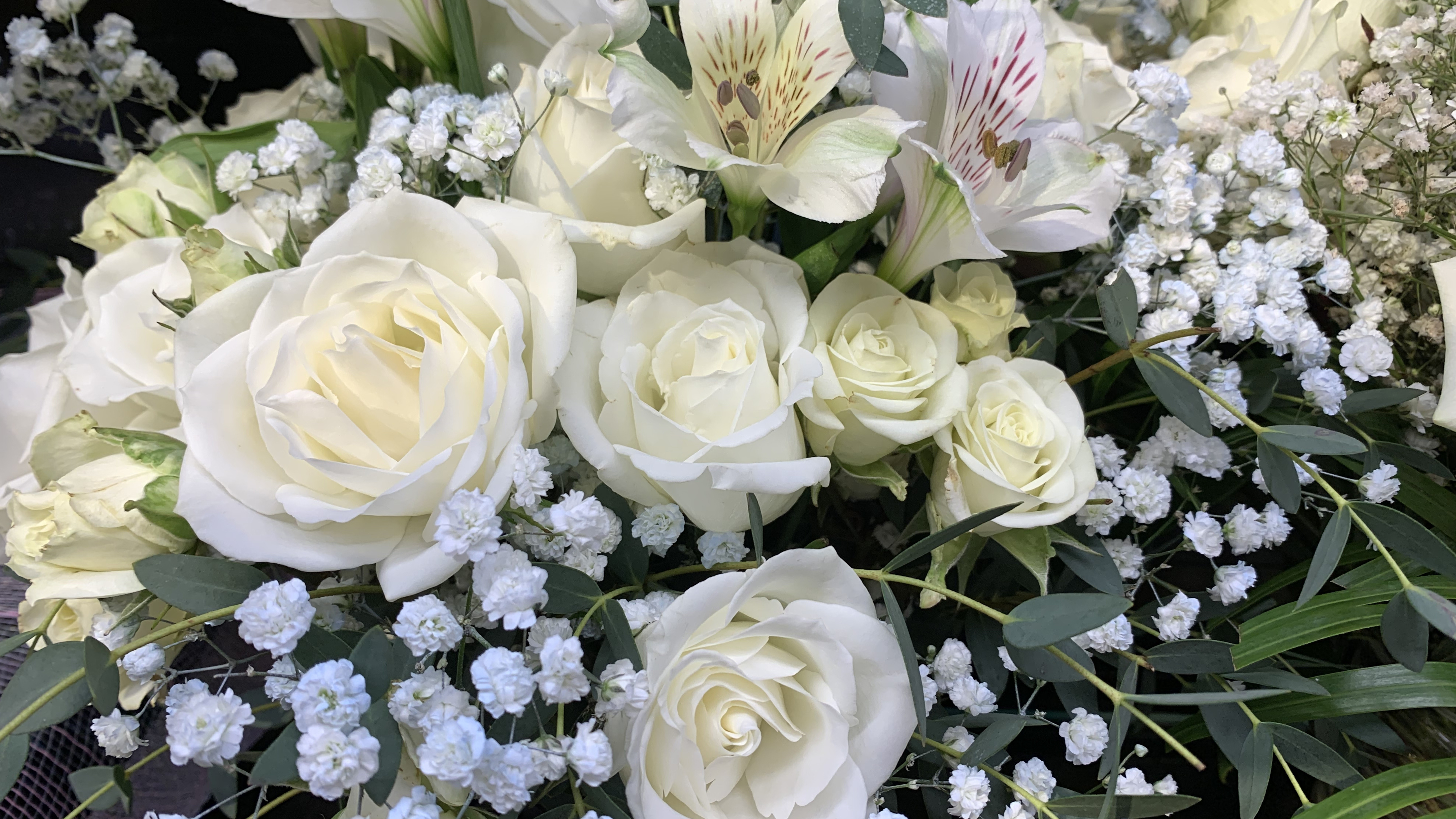
Personally, the smell is what stays with me most. Not what you think. I am talking about the flowers. To this day, my mother tells people, casually, like it’s just a quirky personality trait, that I don’t like receiving flowers from a florist. Not for birthdays, not for congratulations, not from any man, not for any reason. They smell too much like a funeral to me. She repeats it without judgment, just another fact about her daughter she filed alongside blood types and favorite meals. In our family, love has always sounded like this—a little blunt, but very attentive. She remembers what I can’t tolerate.
Just the other day, I walked into a restaurant in Manhattan—big, busy, nothing outwardly unusual—and immediately said, without thinking, “It smells like a funeral in here.” The people I was with laughed, confused. They didn’t smell anything except delicious food and there were no visible flowers, no obvious reason for it. But I swear there was a faint, familiar note in the air that I couldn’t ignore. Two hours later, when we left, we exited through a different door, cutting across another section of the restaurant we hadn’t seen before. And there they were: arrangements lining the walls, towering sprays of lilies and roses, and a small sign near the back indicating a private repast. A picture of a man with black hair. I had caught it the moment I walked in, before I had any proof. I just knew that death was nearby.
Death is the most universal human experience we have, and yet it remains one of the least openly discussed. Why?
When my career as a poet began to take off in 2016, I didn’t completely realize I was writing a lot about death and grief. I was simply writing from the place I knew. And unsurprisingly, the themes followed me. Loss. Grief. Anticipatory grief. Family. I wasn’t setting out to be a grief writer. I was just telling the truth as I understood it, pulling from the language I had been given early on.
What did surprise me was how many people saw themselves in the work. Readers wrote to say my poems gave them language for something they had never been allowed to name. That they felt less alone in their mourning. That they had never heard anyone speak about death so plainly, without trying to fix it or rush it along. Messages came from people who had just lost someone, and from people who had lost someone years ago but were only just beginning to process it. Some wrote to say they shared my poems with their parents, or their siblings, or a friend who didn’t know what to say. Others said they kept certain lines saved in their phones, like something to reach for when the grief felt too big to hold on their own.
What I started to understand, slowly, was that I hadn’t just been taught how to be around my own personal loss—I had been taught how to be around others’ loss. I was given the tools to know how to sit beside someone without trying to fix them. I knew how to let silence do some of the work. There is a kind of intimacy that grief creates, a fast-tracked closeness that bypasses small talk and lands you somewhere more honest. Writing about it opened that same door. Strangers trusted me with their stories, and in return, I held them as carefully as I could.
I realized then that what my parents had modeled was actually community care. Because grief doesn’t belong to the individual. It belongs to the group—something carried together, out loud, with food and logistics and jokes that bordered on inappropriate but somehow helped everyone breathe again.
This upbringing didn’t make me morbid. Well, maybe it did a little bit. But, more than that, it made me capable and empathetic. That’s what growing up like this does. It teaches you to recognize grief not just in tears, but in temperature, in tone, in scent. It teaches you that love doesn’t disappear in the presence of death. It sounds like someone asking if you’ve eaten, if you need a ride, if you’re holding up okay.
Loving people means preparing, because you respect death’s certainty. Grief can’t be fully felt while you’re still stuck handling the business end of death. The paperwork, the phone calls, the decisions that have to be made immediately, whether you’re ready or not. When those things are left undone, mourning gets delayed, interrupted, stretched thin by logistics. Care doesn’t end at death because love doesn’t end. It extends into planning, into making space for the people you’ll leave behind to actually grieve, instead of scrambling to survive the aftermath.
Death is never something separate from life. It is always in the room…and so is love. So, one day, barring a surprise twist, I will end up in the same ground I’ve walked upon my entire life because my parents, who will be gone before me, made sure I was taken care of. I find that comforting.