By Elaine Thomas
A couple sunbathed at the beach on a bright day not so many years after the end of the Second World War. The exact spot along the North Carolina coast, the occasion, and the exact age of each—all those specifics are, like the couple, long gone.
Prone toward headaches, the pretty wife must have taken extra care to shield her sensitive eyes from the glare. Fair-skinned, she no doubt applied and reapplied suntan oil. Her handsome, hardworking husband, already tanned from long hours outdoors, enjoyed the rays’ warmth on his skin. She loved books. He loved her. They both loved the sea.
They’d always loved the sea, even when it separated them. The same waters that took him away as a young sailor brought him safely home after the war’s close.
The peacefulness of their day in the sun ended when the wife fainted. A doctor on duty at the nearby hospital delivered good news: she wasn’t really sick; she was expecting a child. The doctor reassured them that she would be just fine.
Human promises, even those of the wisest, most well-intentioned physicians, expire quickly. Not even two years later the wife, who was by then a mother, became sick, changed forever—partially paralyzed, mind damaged, and hospitalized for the remainder of her days. Forty-five more years, to be exact. She lived trapped inside, never again to see the sea.
* * *
On another day, some sixty-five years later, I sat in front of a computer in that same region’s hospital, checking patient charts. My supervisor, Marty, stepped into the doorway.
“I just got a call,” she said. “Someone collapsed in the hall.”
“And you wanted to make sure it wasn’t me?”
She smiled. “I thought you might care.”
Damn, she had me there. I did care.
I headed down a winding network of hallways lit by fluorescent lights, a chaplain on a mission, looking for the woman who had been hit with the unexpected loss of a loved one.
She’d sunk to the floor, back against the wall. Grief comes in waves; its impact washed her legs out from under her. Good people passing by had stopped, tried to help. One of them must have made the call to Marty’s office.
“I’m the chaplain,” I said.
Parting like a sea, the group moved away. Let the professional handle it. Their relieved thoughts seemed almost audible.
I asked the woman, “Is anyone else here with you?”
“No. The rest of our family lives out of state.”
“How about if, just for now, you let me be family?”
One hand braced against the wall. The other gripped my arm as she pulled to her feet and walked slowly alongside me toward the quiet of the chapel, where we remained until she found firmer footing.
Throughout a long night, as the only chaplain on duty, I answered numerous calls to bedsides. Like every other night, a number of patients left the living. Most were surrounded by family or others who loved them, but not all. A young nurse and I took turns circling back and gently holding the hand of an unconscious woman for a few moments as she slowly slipped away. Did she know we were there? I choose to believe so. I certainly knew that the compassionate young nurse was there.
* * *
Eighteen, what a splendid season. Bright young people filled with promise, drawn from across the country and around the globe, descended on a small college campus, located not on the coast but within easy driving distance from it. A professor strode into class, dropped books on his desk at the front of the room, visually scanned our eager faces, left to right, then right to left, hitched up his pants, and boldly pronounced, “All organisms are born to die.”
* * *
My shift ended shortly after dawn. I left the hospital through a tunnel-like corridor that led out to the back parking lot. After a long night responding to death and trauma, I walked down that tight, dark hallway and out into fresh air and sunlight; every cell in my exhausted body awakened.
I felt reborn. Still, I asked myself the question I’d been asking for some time, “Why would an otherwise sane sixty-five-year-old choose to do this work all night?”
I needed to unwind enough to be able to make up the sleep I’d lost. Instead of heading straight home, I drove out to the beach. Metal plates rattled under my tires as the car crossed over the drawbridge onto the island.
I pulled off my blazer, chaplain’s badge pinned to the left breast pocket, and tossed it behind me back into the parked car. Shoes, too. After twenty-four hours of unforgiving hospital-hard floors, my soles needed the softness of sand. My eyes needed the ocean’s illusion of infinity. The need for insect repellent never crossed my mind. It should have.
Notorious biting midges, gnats so tiny that they’re virtually invisible, haunt the North Carolina coast. Commonly called no-see-ums, they travel in swarms, so stealthy their bites tend to go unnoticed until hours later. Then, relentless itching lets you know a no-see-um feasted on your blood.
Blood was the last thing I wanted to think about. Again, I asked myself why. Why, at a time when I could have eased into a well-earned, restful retirement, had I instead chosen to become a hospital chaplain?
But I already knew the answer. Or rather, answers. Although exhausting and often painful, the work can be beautiful beyond words. That part touches infinity and has relatively little to do with me, other than I willingly answer its call. Yet there is another part that I confess is mine: I’m simply one more wounded healer in a field full of them.
* * *
In seminary, during chaplaincy training, I learned the phrase “reading the human document.” Each process of creation. Words carry our stories. How we use them to shape those stories builds meaning, makes connections, reveals mystery. Listening, really listening, to the story of another is indeed a sacred privilege.
* * *
Standing on the morning beach connects me once again to the story of my parents’ long-ago day on their beach, that day when my mother fainted and my own forthcoming life announced itself.
I grew up visiting her in hospitals and nursing homes. As young as I was when she became ill, I hold no conscious memories of her any other way. I do, however, hold inside myself many stories about her, stories given to me as a child by those who loved us both. Many people, some related by blood, some connected simply through community, said to me in many ways, How about if, just for now, you let me be family? Still, like the delayed reaction of a no-see-um bite, complicated feelings can spring up unexpectedly. All these many years later, grief’s early undertow can still pull me back.
My story of loss is specific, but not rare. Maya Angelou was correct: “We are more alike, my friends, than we are unalike.” In moments of crisis, we all yearn for something larger and stronger than ourselves. One way we can find comfort at such times is through our connections with one another. We need someone to hold our hand. Whether or not one frames it in religious terms, we all belong to the same human family.
Human life, at its best and at its worst, surges as unceasingly as the tides through hospital doors and hallways. Individual and collective shorelines shift in the flow. Any one among us may at any moment be forever altered. My experiences as a child make empathy for other families caught in crisis second nature. Therein lies my own personal best answer to the funny, funny riddle of this life. And to the decidedly non-funny riddle of why, at my age, I’ve become a chaplain. Ocean, sweat, tears; mine is a saltwater vocation.
* * *
In an earlier professional role, as a then-young white woman working within a largely minority school system, I watched an older African American principal approach retirement. His tie and
pocket square always matched. One’s work matters. I will always remember him, his precision and purpose, how he knew every child by name, every family situation. Asked what he might like for his retirement celebration, he had one simple request. He wanted everyone present to join him in singing a song he loved, “May the Work I’ve Done Speak for Me.”
* * *
I came to the beach exhausted after a long night. There have been other days on this same shore, times and occasions untouched by grief or questions. One brought me pure magic. In damp, chilly weather with no one else on the beach, I knelt, sifting through shells, my back toward the water. Nothing could be heard above the roar of the breakers, yet I suddenly felt something call to me. I spun around. Mere feet away, a school of dolphins rolled in the waves. As they passed, I felt that somehow, in a manner far beyond my own capacity to understand, they’d invited me to play.
No playful dolphins greet me this morning. Washed-up jellyfish dot the line along the sand where the water begins. A prominent core of red in each transparent body makes me think of the human heart.
Something brushes my jawline. A midge bite, no doubt. As much as I dread the inevitable misery of its delayed response, this particular no-see-um reminds me that we humans are connected not only with one another but with other forms of life, with all of creation.
Only the female midge bites. She seeks our blood not from malice but out of simple necessity, so that she can provide the high-protein environment her eggs require. Our blood becomes part of her generational continuum. Could such a tiny creature possess awareness of what a privilege it is to swim in this unpredictable sea of life? Certainly not in our terms. Yet I choose to think so, to believe that in some mysterious way even the no-see-um might connect to larger wisdom.
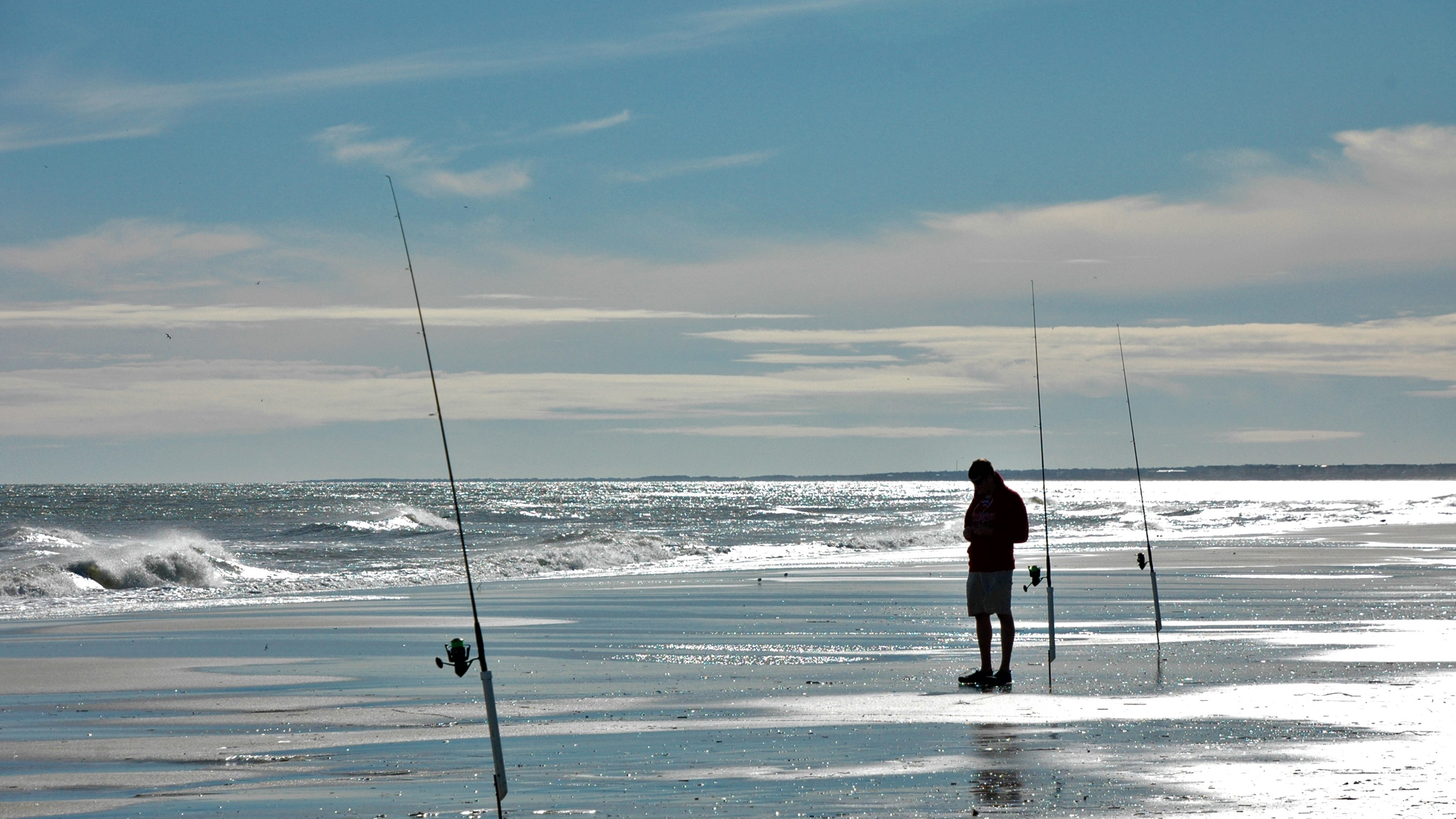
A nearby fisherman draws my eye. A Carolina-blue baseball cap pulled low hides his features from the sun and from my vision, but I pause for a moment to admire his practiced form as he casts into the surf. Words printed on the back of his sweatshirt remind me, “grits are good for you.”
I take one last long look out across the waves, then turn to head back over the bridge toward home and breakfast, grateful to be hungry and alive.