By Valerie Georgoulakos
“I‘ve lost my knitting bag,” I said, “with all my needles.”
The woman at the yarn store showed me some new needles, but they were all circular.
“Oh no,” I said. “Where are the straight needles?”
“No one uses them anymore,” she explained. “These are easier, and you can’t lose one.”
She still carried a few straight ones, though, and showed me some that looked like bamboo sticks.
“They’re too short,” I said. “I knit with a needle under my arm.”
She smiled and asked if I was Italian.
“No, Greek.”
“Ah, that’s how Italians and Greeks knit.”
“My mother taught me,” I said. “A lot of the needles were hers.”
“You want the long, colored aluminum ones, right?”
“Yes, those are the ones.”
My mother taught me to knit when I was three years old, and over the years I knit in bursts, stopping and starting again, sometimes for years, depending on what was happening in my life. I have a brown tweed sweater from when I quit smoking, a box of little fruit-shaped hats I made for my son when I was pregnant (I took a knitting class instead of Lamaze), and a white alpaca sweater I made one cold, snowy winter. Although I loved to knit, I wasn’t as good as my mother. Her stitches were always even, and she knit fast, one needle under her right arm, the other moving quickly. She understood intuitively how to shape a garment, adding and decreasing stitches as she went along, and never used a pattern.
When my mother’s health started to deteriorate, I was shocked, even though she was almost eighty-five years old and had had Alzheimer’s for twenty years. She had been sick for so long—her illness such a constant—that I expected her to stay that way.
My mother was always talented with her hands. She made delicate triangles of spanakopita and S-shaped koulourakia cookies for Easter. She put up shelves, cleared the roof gutters, cut the hedges and my hair. She had her own power tools. She could open any jar. Best of all, she could sew anything. One spring, she made my sister and me matching blue-and-white capes and a pale-yellow wool coat for herself. Growing up, I never paid attention to sizes or details when I shopped. I knew my mother would alter the dress to my size, shortening or removing sleeves, bows, collars. I could bring her an ill-fitting dress in the afternoon and she would fix it, and trim my bangs, in time for a party that evening (and then drive me there). Even after she became ill and couldn’t remember names or what she had just eaten, for a long time her hands still knew what to do. I remember her sitting on the floor of my studio in the West Village hand-sewing a brocade cover for my futon couch. She kept stopping, needle in hand, and I had to nudge her to get her going again. But ultimately her hands failed, as everything did.
As my mother declined, all I wanted to do was knit. It was a connection to my mother, to something we shared, to a time when she was whole; and to the tangible warmth and comfort and feel of wool, sheep, nature. But I also wanted the magic of knitting, of creating, of bringing something to life. You take a piece of yarn and two sticks and somehow, stitch by stitch, a scarf or a hat or a sweater appears. And you can unravel it and transform it into something else anytime you wish.
When I couldn’t find my knitting bag, I remembered the little yarn store in the East Village I had liked so much. It wasn’t until a few days after my mother’s funeral, though, that I finally made it there. When I set off, on a gray February day, I had only a vague idea where the store was. I hadn’t thought to look it up. I just headed east on Fifth Avenue. I was in a bubble, cut off from the world around me. Something momentous had happened to me, but the world went about its business. People chatted, walked their dogs, carried groceries. I wanted no part of that ordinariness. Those everyday things, I knew, would slowly turn my mother’s death into just another event. In my bubble, her death was a catastrophe, and I wanted to keep it that way. Walking over, holding my sadness close to me, I felt my mother close too.
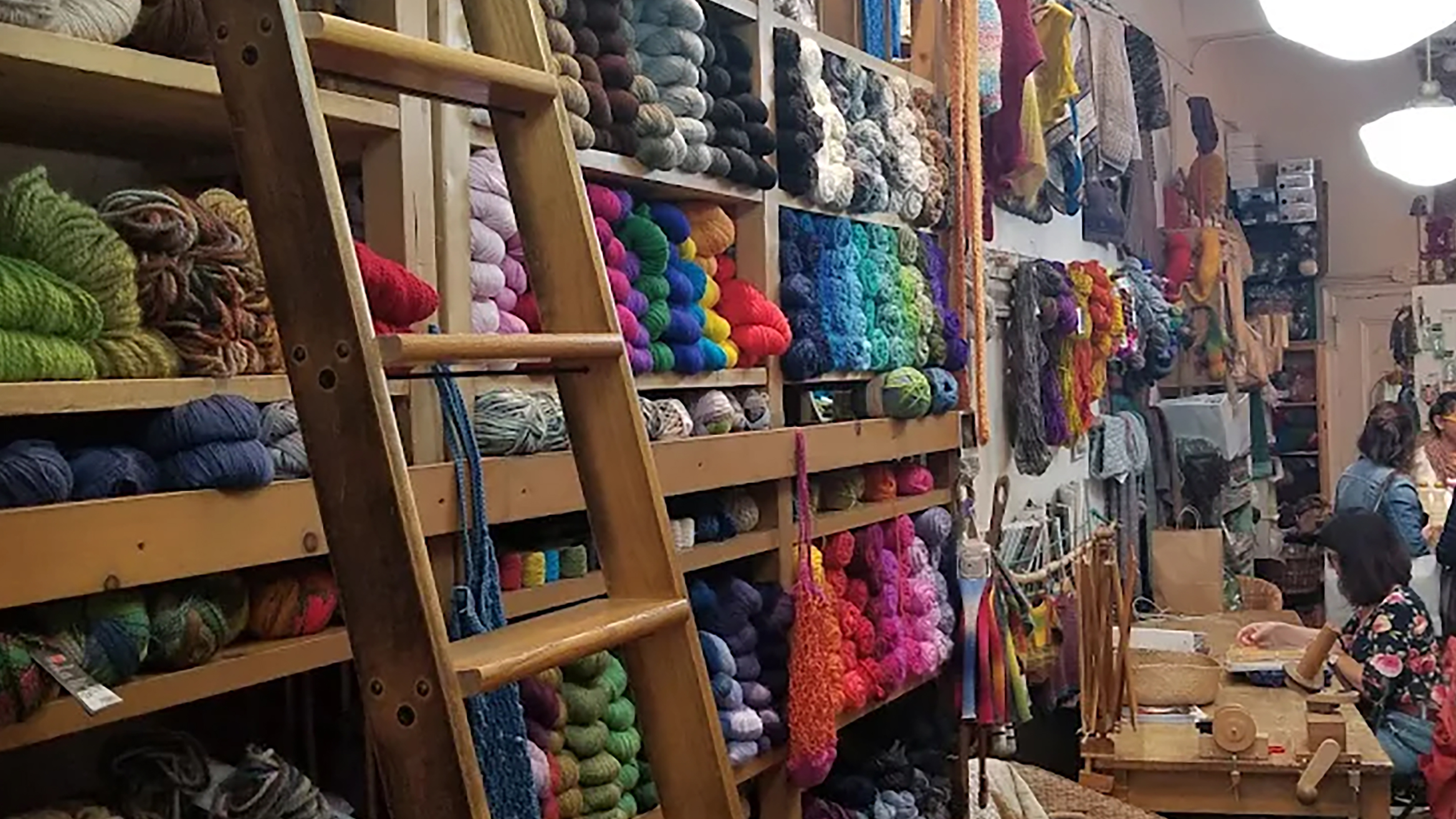
In that hazy state, I made my way to the shop. It was called Downtown Yarns and was just as I remembered—long and narrow with a screen door and bookshelves filled with yarn from floor to ceiling. The owner, Rita, was down-to-earth, with warm brown eyes and in her mid-fifties like me. Frankie, her golden retriever, was asleep and breathing heavily under the long wooden table, as she had been the last time I was there, five years earlier. On top of the table was a yarn spinner, for winding skeins of yarn into balls. I had never used one. When I was a child, I would hold up my arms, and my mother would wrap the yarn around them to straighten it before winding it into a ball around a small piece of cardboard. I still do it that way.
I pointed to a sweater. “I like that one,” I said. It was old-fashioned, an orangey-cream color, with a delicate bow pattern and tiny buttons, not really my color, more my mother’s, with her blonde hair and green eyes.
“It’s a copy of an old cardigan I loved that fell apart with age,” Rita said. “I didn’t want to part with it, so I had a pattern made and knit a new one.”
Of all the garments in the shop, I had chosen the most magical, imbued with love and loss.
Rita let me take my time. She seemed to sense I was sad and that this was important to me. I decided to try the pattern, although it looked difficult, and I chose a thin, fuzzy soft-brown alpaca yarn. “I think you can do it,” she said. “It’s like that beautiful white alpaca sweater you made.”
So, she did remember. I thought she recognized me when I came in, but I wasn’t sure. It had been a long time. It felt like a hundred years. Then Rita said she might even have some needles like the ones I had lost. She looked in a pencil holder full of old discarded needles and pulled out a thin mint-green aluminum size two, like my mother’s. It was the size I needed and fit under my right arm. The other needle was bent, but I didn’t mind. “I’ll take it,” I said, straightening it out enough to use.
Rita seemed as pleased as I was and wouldn’t take any money, saying, “I’m glad these have a good home.”
I left feeling like I had found a bit of my mother. I wished I hadn’t lost those needles of hers, but these were close. I wished I still had some of her V-necks. I wished I had everything she ever made me.
It was like going back in time—the shop, the dog, the woman, the mint needles—they were all in the bubble with me and my mother was young again and could do anything. Rita seemed to understand. “The important thing is to get you knitting again,” she said as I left.
That was more than ten years ago. The bubble is long gone, worn away by the everydayness of life, as I knew it would be. But when I go to my mother’s grave, I am reminded of the feeling I had when she first died. Even now, there is a wrongness in the sight of the tombstone with her name and dates.
As for the brown cardigan, I’m still knitting it. Here, too, life intervened. I moved (twice). I renovated. I packed my son up for college. I started writing more and knitting less. Each time, I put the sweater aside temporarily, and there it sat in my closet, sometimes for years. A Greek proverb says, “Nothing is more permanent than the temporary.”
The project has also been more challenging than I expected. Because the yarn is thin, dark, and fuzzy, it’s hard to see the stitches and easy to make a mistake. By the time I notice I’ve dropped a stitch or missed a row of the pattern, I’m several inches farther along and have to rip it back and start again. After ten years, the back and the left front, where the buttons go, are done, but the right is unfinished, and there are no sleeves yet. I was always an inconsistent knitter, but that’s a long time, even for me. I do think I’ll finish it one day, though I don’t know when. What I do know is that with each year that passes, it’s been that much longer since I last saw my mother or heard her voice. And so, everything connected to her, no matter how small, feels important—even a half-finished sweater.