By Catherine Rossi
I stretched in the pew to ease the muscles still stiff from yesterday’s blur of highway miles and scanned the church for Jenny. Beside me were two friends—good friends—that I hadn’t seen in a decade. I shook my head, realizing that somewhere amidst the orange construction cones I’d let myself believe I would be seeing my childhood best friend. But Jenny wasn’t there.
My eyes traveled to the front rows and tried to match the sixty-year-old faces with the brothers and sisters that I barely remembered. I took in the life-sized poster, complete with Jenny’s engaging smile and playful expression. When the minister began speaking, I turned to the podium. I tried to listen, sure she would say something profound and comforting, sure she would make sense of the sudden illness. Instead, memories of Jenny flooded my senses.
We met in Mrs. Hirn’s split class, consisting of third- and fourth-graders. Both third-graders, we were deemed independent enough and smart enough to handle the mix. Our fathers were professors at the university, so we also had that in common. She lived nearby on my walk to school. Just turn the corner, cross the street, and count to the third house.
But Jenny was more than a friendship of coincidence, a friendship of geography. She was the first girl who’d picked me. The first girl that I’d picked. In those elementary school days, we were inseparable. She was my seesaw partner—the only kid I trusted to not suddenly jump off, causing me to slam to the ground in a terrifying jolt. After school, we would shoot baskets in my driveway or we’d ride bikes back to the playground where we had full reign over the slides and swings.
Jenny’s dog, Benjie, was our constant companion. He was the coolest dog ever, not just because he looked like and had the same name as the dog in the blockbuster movie, though that helped. We took him on endless walks, even in winter when his tiny legs struggled to climb over the huge snow piles lining our neighborhood. I loved that dog as much as Jenny did, like he was my own.
There were other girls who could have been my best friend. I played with the girl next door daily, but she was half my age when I was six. And there was Debra. The two of us were the only kids who knew how to read when kindergarten began, so twice a week we met with a tutor. Together, we sounded out syllables, filled in worksheets, and earned gold stars. A few years later Debra moved away. When I saw her again, freshman year of college, she didn’t remember my name. Jenny wouldn’t have forgotten.
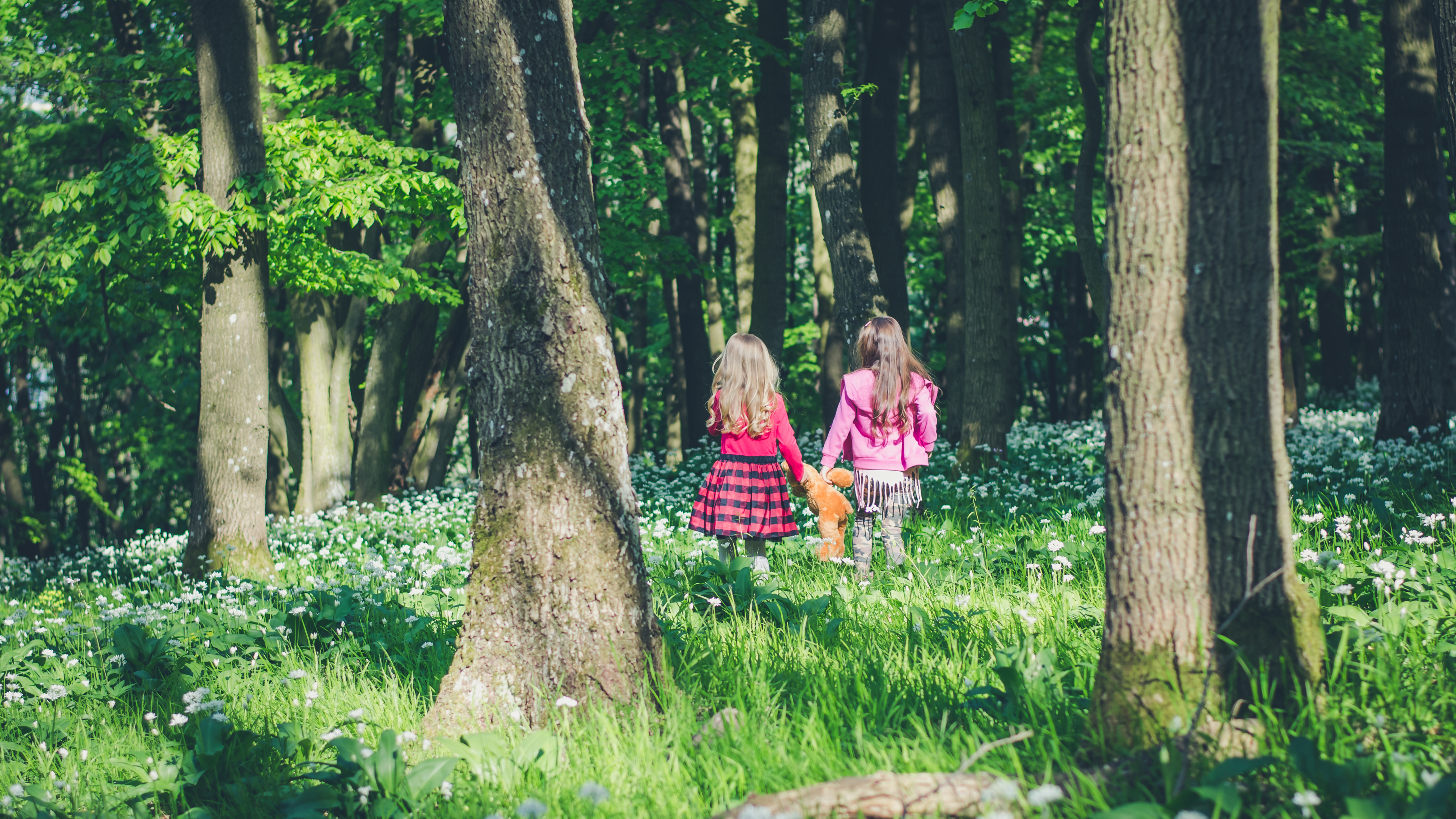
It was Jenny who decided we should walk home from school through the woods. School rules prohibited walking that way, so I was reluctant, afraid of who knows what punishment and of who knows what terror awaited. But Jenny convinced me to walk on the path that wound through pussy willows and reeds and then into the woods which backed up to her house. Nothing bad ever happened, and perhaps I learned to bend the rules a little.
A few years later we had a fort in those woods and played there after school. The fort was merely a few logs placed around a campfire site. High schoolers used it for older kid activities as evidenced by the empty beer cans and the wrappers not for candy. Still, we added worn out toys and called it our own.
The year we met, I had my first crush. Bryan Dexter was an older boy, a fourth- grader in our class. Much to my dismay, Mom discovered the paper where I’d written my fantasies over and over: “Mrs. Bryan Dexter. Bryan and Cathy Dexter. I love Bryan.”
That night, Dad questioned how I could be in love with this boy. “Has he ever taken you to dinner?” he asked. I was too embarrassed to answer that going out wasn’t the only way to fall in love. Too tongue-tied to say that I was nine and always ate dinner at home.
But Jenny didn’t tease me. She didn’t laugh or nudge me when Bryan was around. When I had my next crush, she took the news of that in stride as well. That time I carefully hid the secret from my parents, but I still showed Jenny the paper covered with my desires: “Mrs. Winkler. Henry and Cathy Winkler. Mrs. Fonzarelli.”
In junior high, Jenny was the first of our friend circle to host sleepovers. Half a dozen girls would pile on the living room floor in our pj’s and sleeping bags, doing makeovers, playing truth or dare, and chanting “stiff as a board, light as a feather.” After dark, we’d sneak out to walk past the houses of boys we liked. I’m not sure what we expected to happen on those walks. The boys never ventured outside, but probably heard our loud whispering and giggling, announcing the secret crushes.
Amongst all those girls, it was Jenny who was my best friend. And I was hers.
I was startled out of my reverie when one of the friends I was sitting with walked up to the podium. Refocus, I told myself, and pay attention. And so I laughed along as she described our private jokes. I cried with her as she mentioned parties and birthday cakes. But when she described Jenny as a cat person, I cocked my head. That wasn’t right. When she stated how she and Jenny were best friends from elementary school through high school, I froze, wondering if I’d heard correctly. She must be remembering wrong.
I mean, I knew we’d drifted apart. In eighth grade, Jenny’s family moved a few miles away. She still lived close enough to attend the same school, but too far to walk together or pop by after class. We were still good friends—close enough for group hang outs and parties —but not best friends who shared every crush. Eventually we ended up in completely different circles. By senior year, our paths didn’t even cross enough for her to sign my yearbook.
This other friend, though, the other best friend, had been closer to her in high school and had kept in touch over the decades. She deserved to be up there, speaking to the crowd.
But what about back then? Was she right?
Had Jenny secretly been fed up with me and my lack of personality? My lack of adventure? Was I not enough for her? The thought was mind boggling. If I was sure of anything, it was that Jenny and I were, at one time, best friends.
If that was wrong, then every foundational truth from childhood was questionable. Truths like the snow must be shoveled by the time Dad got home from work or else it will stick to the driveway all winter. Truths like when confronting a bird who’d gotten into the basement, you must wear a clothes basket over your head. Or was this another lesson I would learn the hard way? Lessons like most adults didn’t get the summer off work.
I had to be right.
After all, I was the one in third grade that Jenny fell on top of when she fainted. I was the one standing next to her in our fourth-grade class picture. I was the one allowed to bring her homework and return the class gerbil when she had pneumonia.
And I was the one our fifth-grade teacher pulled aside after Jenny’s mom died of cancer. He was a tall, lean, affable guy in his twenties, who made us practice writing his name on our weekly spelling tests: M-R-.-S-C-H-R-E-U-D-E-R. He closed the door and told me that I was Jenny’s best friend and that I needed to be there for her. Short of other ideas, I convinced the girls to write sweet messages on pieces of tape and stick them on her desk.
I knew that our friendship, like all friendships, wasn’t perfect. I remember getting frustrated that she walked at a snail’s pace, making us occasionally late for school. One time when her dad had driven us to the beach for the day, I overheard her complaining to him that I was boring. She’d just asked me what I wanted to do and I didn’t have an answer. I just wanted to do what she was doing.
As my attention drew back to the funeral and the music washed over me, I wondered— even if this other girl and Jenny were best friends, did it matter? After all, those events happened fifty years ago. The pussy willows were long gone, the woods cut down for houses and a bike path, and the playground paved over for a new school.
Friends like Jenny—best or not—were a treasure, hard to come by. In the decades since then, I could count my best friends on one hand. As a young adult, part of me actually hoped that my long-term boyfriend wouldn’t propose so I wouldn’t have to scrounge around for a maid of honor.
Last year, after Jenny and I reconnected on social media, she sent me a booklet of drawings I’d created for her fifteenth birthday. One picture contained our circle of friends, drawn as stick people, each with the correctly crayoned hair. We were sitting around a table with Jenny at the head and a cake in front of her. Because it was her birthday, I had written, she was the only one in the picture with fingers.
I appreciated that Jenny had kept that booklet for so long and then shared it with me. It was a light into who we were, as well as a confirmation that my sense of humor hadn’t changed much. She sent it after an article I wrote was published, claiming that the booklet was my first publication. That was Jenny, still celebrating me, affirming me, after all these years.
I shook myself as the service was ending and the music faded. I didn’t want to feel regret or sorrow about not staying in touch, about not being a better friend. And so, I could only draw one conclusion. If I wasn’t her best friend, that didn’t make our friendship less than it was. It didn’t diminish my memories. Nor did it say anything about my insecurities and faults as a child.
Instead, it said a lot about Jenny—that she could be so much to so many people. That she made everyone feel special.
I’m sad she’s gone. Sad at the suddenness of it. Sad for her family. Sad for her friends. Sad for me.
But I’m happy she was an influence in my life. She showed me it was okay to draw outside the lines, to walk through the woods. She showed me strength during tragedy. She showed me how to have fun. She showed me how to be a friend to all. That was all I needed to remember.
RIP, my friend.
Given that her parents met in a library, it is no surprise that Catherine Rossi owned a library card at age four. After graduating from the University of Michigan with a BS in computer science, she had a lengthy tech career, where she wrangled words and people as frequently as code and data.