By Baylie E. Vike
In a small, tree-lined, and largely hidden part of Dallas, there is a graveyard where my great-grandparents McEvoy are buried. Every couple of months, my nana makes the hour-long drive there to place flowers on their graves. My family has a long history of honoring the dead. My nana will tell stories from ages ago of her family, my grandaddy’s family, and of their lives when my dad and uncle were growing up. We take out the old things from the cedar chest and try on Nana’s old clothes and read my Grandma Mary’s journal. We carry her legacy home with us in the form of her paintings and crochet blankets, which Nana gives away freely. She was artistic, wonderful, and made the best homemade rolls. We have tried and failed to recreate them.
Nana has taught each of her five granddaughters to honor those who came before. We carry little bits of them in us. I want, in the only way I know how, to honor my mom. She was very secretive—I won’t tell her secrets. We were very different. I won’t talk about our complicated relationship. She loved me more than I think anyone ever has, and she was the strongest person I know. I carry her with me daily. I would not be writing a book or traveling the world or speaking other languages without the way she invested in me. It’s hard to say whether she would be proud of me—I spend a lot of time in bars and have a bad smoking habit. But I think we would have an understanding. An appreciation for each other that only comes with time—time we didn’t have. I think often of time as a bully that won’t stop punching. It is the only precious resource we have—so often discarded for cheap pastimes. But it also heals. In the eight years since my mom’s passing, I have found ways to honor her without the grief consuming me. With this time I have had, I’ve finally found the strength to tell the story of what happened, and the story of her legacy.
My mom’s name was Julie. Her best friend called her Jules, and I often think of her in that way. She was always laughing and smiling, but especially when Kim was around. They would laugh about everything and talk for hours. Our families went tent camping together and had close calls with skunks around the campfire. We spent New Year’s together and liked to go to book fairs together. My mom homeschooled me and my three siblings, and she and Kim would discuss curriculum for hours. I often have mixed feelings about homeschooling. I find it to be broadly problematic. But my mom, as a former public school teacher and lifelong learner, knew how to invest in us. She let me read everything, and taught me writing, history, and Latin. Math was a trouble spot for both of us, but we did our best. Jules ran the family like the mob, as I often joke with my sister Emalie. We made Italian food all the time despite not being Italian. She loved “The Godfather” movies. She was stern when it came to discipline and encouraged us to stick together. I credit her family values as the thing that held both my mom’s and dad’s sides of the family together during her illness. She was the glue. She was everything. I don’t think she would have ever admitted to that, but it was true.
My mom got sick when I was fifteen and about to start my sophomore year of high school. My siblings and I were spending the night with Nana—Dad’s mom. Nana and I were on the front porch. I was reading my Bible, still emotionally high coming off a week of church camp. Nana was asking me questions when she got the call from my dad.
“The doctors found a spot on her brain,” he said, as I remember hearing through Nana’s phone. I believe Nana asked how. “She had a seizure on the way to the doctor,” he replied. “They’re running more tests.”
Nana and I took deep breaths, letting the precious air from our mouths hang there on the patio. We agreed not to tell my siblings. That was the first time I remember having to be strong.
My next memory is of my Uncle Rodney driving us to the hospital to meet my parents. He was a fireman like my dad. He led us like little ducks behind him through the back part of the hospital where the ambulances pulled up, weaving in and out of a sea of personnel. He had been here a million times. Nurses with eye bags and clipboards lined the halls and stared at us blankly. Paramedics beelined it for stale coffee. The coffee aroma mixed with the sterile, bleach-scented air completed what I could best label the stench of a human graveyard. Doctors milled about and discussed treatment plans and surgery recommendations with those ghostly nurses. I remember it being about three in the afternoon. Why was everyone so tired? I didn’t have time to be scared or sad—I wasn’t sure what to think. But I had never seen a hospital like this, even when Grandma Mary died. In this hospital, we were in the trenches, seeing the soldiers that filled them. This was the dogfight for life. The emergency room is a purgatory of the most terrifying kind. I would have even preferred an ICU, in hindsight. At least in the ICU, we knew what we were dealing with. Here, the answers lead only to heartache. Here, my footsteps carve a path to a future I don’t want to see. I was fifteen—I knew what brain cancer was. We didn’t need to say it. I knew, before even reaching the room, that it was bad. I knew it would change the course of my life along with my mobster family who protects me so. Uncle Rodney seemed to know right where Mom’s room was without anyone telling him. It was the greatest love he had ever shown me—leading us through in paramedic-mode to the scariest part of our lives so far.
It was a clown-car room. My mom’s brothers were there. Her parents, my grandma and grandpa, were there. My grandpa occupied one of the two chairs. My siblings, Nana, Grandaddy, and I piled in. Uncle Rodney, Aunt Wendi, and my cousins joined the crowd outside—my aunts on my mom’s side and some close family friends, the Greys. They all looked somber—they knew what I knew and what we all didn’t know. A radiologist, who was also a close family friend, entered the room. He told us that Mom had a brain tumor and she would need surgery. I don’t know at what point we knew it was terminal—before or after they operated—but it turned out my mom had stage IV glioblastoma. She had, maybe, a year to live.
I remember the moments after surgery in the ICU, moments that would echo fifteen months later. “Hold her hand,” someone told me, “and talk to her. She hasn’t woken up, but she can hear you.” I walked, alone, into a room that smelled like nothing and felt arctic cold and huge. I had to traverse an arctic gorge to reach my mom’s bed. Stitches jutted out of the shaved half of her head— big stitches. Like a large centipede had made its home on her head, never moving, and marking a great divide in our lives—the before, and the after. My childhood, and my adulthood. I was no longer a child. I held her hand and said words that I can’t remember now. There was a long silence, and then she squeezed my hand. A weak, intentional squeeze. She heard me. She was going to be okay—I remember thinking that, for a moment.
My mom lived for fifteen more months. Eight years later, it is hard to speak about those times. There was the moment when she spoke her first words after they told us she may never speak again. Seconds passed, seemingly interminable, as she searched for a sentence and then found it. There were moments of frustration when she couldn’t find the right words. There was the moment when my dad came home from work crying with more money than I had ever seen: $14,000. Collected by the fire department. There were moments when we had too much ice cream. Moments when friends from church brought us awful food and Dad would say, “Let’s go get Chick-fil-A.” There was laughter through pain. There were moments like my first job, first dual credit class at community college, my driver’s license, and more milestones, some of which she saw, and some of which she was too sick to notice. There was the moment when Nana couldn’t teach my two youngest siblings anymore and they were enrolled in public school. There were moments of prayer, which my family often shared, and with which I was growing disillusioned. Cancer is the true bully. Cancer is a serial killer. I grew very angry, numb, and distant during those times.
Weeks after my seventeenth birthday, my mom slipped into a coma. And then we had a hospice nurse.
The call came when Emalie and I were away at our dear friend’s house. The Grey family had walked with us, tirelessly, through the illness. Mrs. Grey answered the phone, ushered us into her car, and then she and her daughter, Emily, held our hands as we drove home to see our fighting, mobster mom for the last time. It was the greatest way they could have shown their love for us.
Mom’s bedroom seemed darker than before, as if they dimmed the lights just for this moment. Mrs. Grey and Emily stayed outside while Emalie and I walked in and were greeted by the somber faces of both sets of parents, the hospice nurse, and our dad. He was lying on the bed holding my mom’s hand. Grandpa was seated in a chair next to the bed holding his little girl’s other hand. It was the most heartbreaking sight I had ever seen. I had never seen my grandpa cry before.
Nana and Grandaddy were trying to be strong for us, and for their son, I think. I could see it on their faces.
I didn’t know what to do with myself. Grandpa got out of his chair, called me over, and sat me down.
“Now you hold her hand,” he said, “and talk to her. The nurse says she can still hear you.”
That was the greatest way my grandpa had ever shown love to me.
There are no words to describe the way in which someone passes from this life into the next. It is ugly and grotesque and a sigh of relief all at once. In the chair my grandpa gave me, I watched my mobster mom fight for breath repeatedly as my dad sobbed into her ear that it was okay for her to go now. The room echoed his cries like a weary Tchaikovsky symphony, and I squeezed her hand tighter and counted the seconds between her breaths. There were so many seconds. Seconds I cling to now, and seconds I will cling to later.
I think about time and what a bully it is. Our lives are merely blips on the radar of the ever-expanding universe—these seconds seem linear, bent toward oblivion. But I also see time as circular, swirling throughout the room, enveloping us, giving us just a few moments more.
Soon I was chanting with them that it was okay for her to go, that I loved her, and that I’d see her soon, but as the seconds grew longer, I found that I didn’t believe it was okay for her to go. At seventeen, I needed my mom, and I wanted the mom I was getting close to and making spaghetti with at fifteen before she got sick. I didn’t want her to suffer, I didn’t want her like this, but I did want her back.
I began to sob. I wasn’t ready. I knew, but I would never be ready.
The room grew silent.
There are images that will stick in my mind forever. Like the Plano Fire Department lining the walls of the funeral home to show their silent support for their Chief. Or my little brother Ben, just ten years old, helping to carry the casket with his brothers. In the front row and wearing my favorite black dress, I cried—not enough to match what I felt inside, but just enough for show.
An endless stream of our friends and family hugged me and my siblings as they left the funeral. After the graveside service, our church served us a meal in the janky office space we worship in. It tasted good, and I laughed with my friends as they tried to cheer me up.
The guilt settled in as the friends and family trickled out of the building. I had laughed at my mother’s funeral.
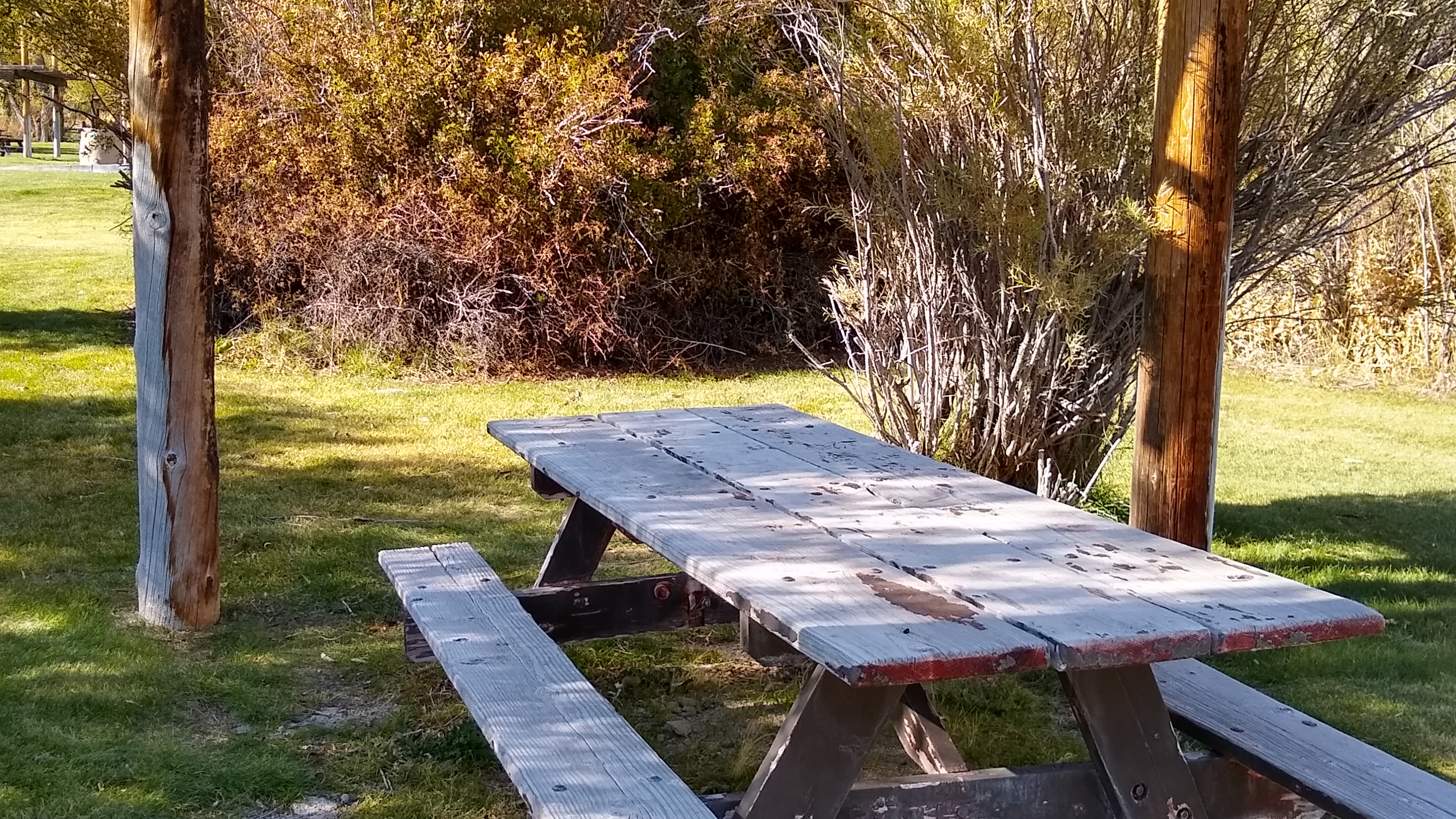
While I am not sure I believe in Heaven anymore, I think sometimes that it might look like our backyard at 109 Thoroughbred—endless fields of green St. Augustine and picnic tables. It is always summer, and Mom’s hair glows again like real gold. Sometimes I can hear her laugh. I don’t know if she smiles at me from wherever she is; she might be too busy laughing, but I like to think I will see her someday. She will be seated at our old picnic table under the arbor—our footprints in the cement forever—and she’ll beckon me. Come sit awhile, she’ll say, and tell me about your day.
I will sit down beside my mobster mom, and we will have all the time in the world to catch up. We will have all the time in the world to make it okay again.