By Anna-Christina Schmidl
My grandfather was a lucky man. My father, not so much. He didn’t wake up one morning, dead of a heart attack at 49. My brother and I, twins, were 14 at the time. I will never forget my mother’s screams: “Anna, Anna, Dad is dying!” It was Wednesday, 3 December, 5:35 am.
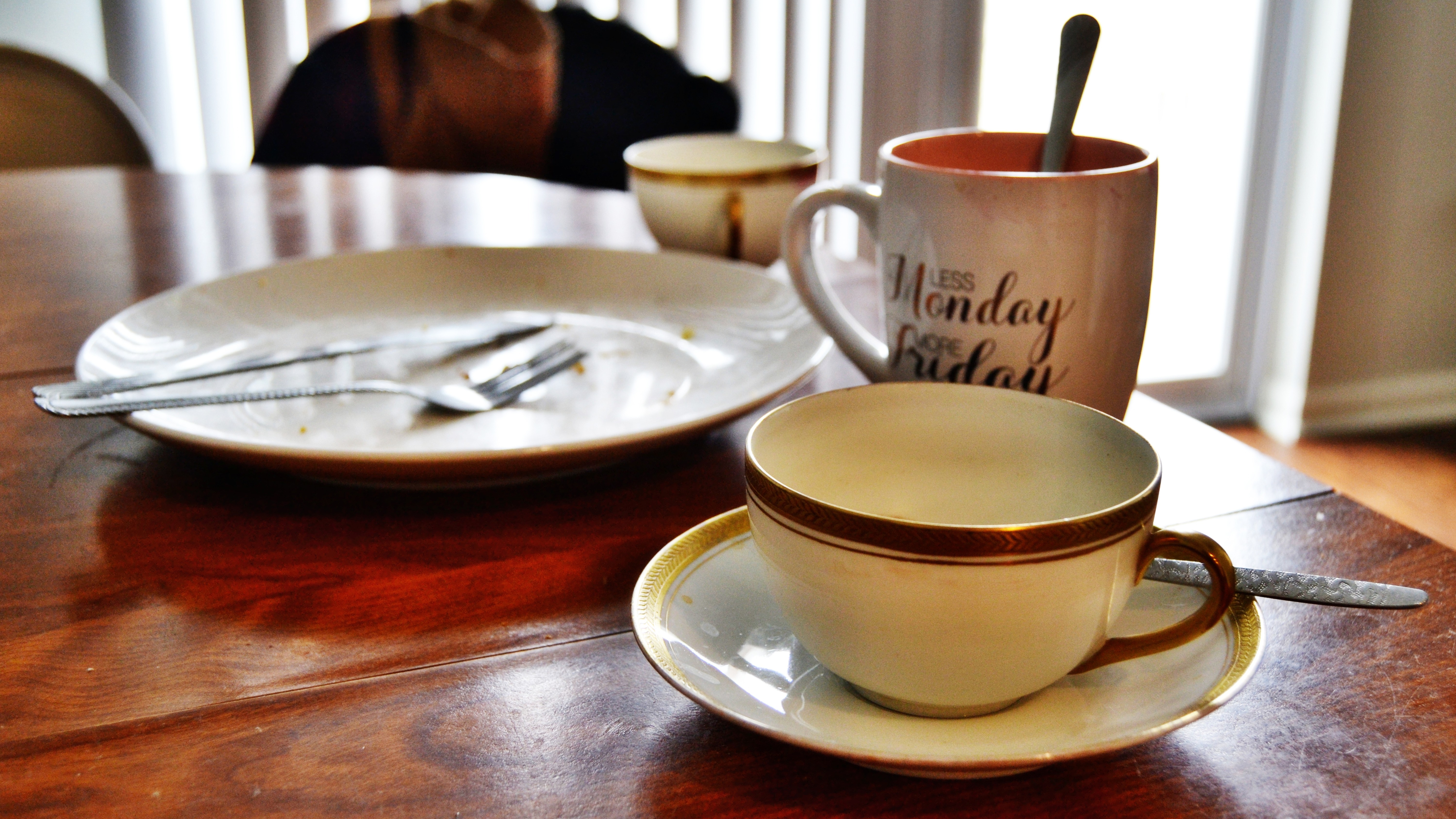
On Sunday, 30 November, we had our last breakfast together. I took a photo of the dining table on my phone, of the breadbasket and jam glasses and empty plates with floral patterns, covered with salt crumbs. On Monday, 1 December, I complained about having to study for my religious education class the next day.
“There will be moments when you will need it,” he said, like a prophecy.
The funeral took place on Saturday, 6 December, St. Nicholas Day. I read a passage from Corinthians in church: “The last enemy to be destroyed is death.” I didn’t believe any of it. I wore black sneakers with tiger prints, and my shoelaces came undone. I almost tripped on my way to the lectern. The priest referenced a character in Hemingway’s Islands in the Stream who, upon finding out that two of his sons have died in a car crash, tells himself: “Write them off.”
“God does not write us off,” he said.
On the way back to our car, I saw my father walk among the crowd. At home, I asked my mother for permission to watch a movie, Oliver Stone’s JFK. I never finished it, not to this day.
My grandfather taught literature and history. His favorite writers were Goethe and Thomas Mann, and his favorite piece of music was Mozart’s “Ave Verum Corpus.” He was gentle and calm and good-tempered and wise. He loved my grandmother and us grandchildren. He loved grocery shopping and taking care of his garden and the mountains and the rugged shores of the North Sea.
After my father died, I listened to Sum 41’s new album, Underclass Hero, on repeat. I wrote “no home no hope no life” on my Converse, and I cut my left arm open with a razorblade. I read Emil Cioran’s On the Heights of Despair and All Quiet on the Western Front by Erich Maria Remarque. I read it with fervor until the words rang in my ears, and the landscapes ravaged by the First World War—the trenches, the stench, the grenades, and the blood—became familiar, enveloping me like a coat, a blanket, a home. Each winter that followed, I reread it, and it felt like opening up an old wound, the pain still there —sometimes a sharp sting, sometimes a dull ache, but above all it was something I knew, and it was proof that my father was not forgotten.
My grandfather was healthy until his 90s. He looked younger than his age, and people sometimes mistook him for my father. My grandparents often came to stay with us for extended periods of time, and he played football with us and picked us up from school and drove us to appointments. He baked waffles and cheesecake and cooked strawberry jam.
My father was a lawyer. In his free time, he liked to read biographies of Napoleon and Charles de Gaulle. My earliest memories are of him watching black-and-white World War II documentaries, much to the dismay of my mother. “Not in front of the children,” she would say. On his 49thbirthday, eight weeks before his death, my parents bought a new house away from my hometown. I told my friends that we were going to move, even though they’d asked me not to. Afterwards, I had a few shots of Baileys at a friend’s house, the first time I consciously remember drinking alcohol. For a long time, I was convinced that’s why my father died—because of my transgressions.
The final year of his life, my grandfather was almost blind, and he suffered from advanced heart disease. He was very weak, and most of the time he sat in an armchair sleeping. It was difficult to see him suffer.
The events are seared in my memory. I remember the days of the week and conversations in the days leading up to my father’s death as if it were yesterday. Snippets of memory that come back to me in moments when I least expect it. Sometimes I think of all the things my father never saw me do – graduate from high school, choose a path. He’d promised to dance the Kaiserwalzer with me at my wedding. I am not sure I still remember the sound of his voice. We shared a lot of interests; there are so many things I would have liked to ask him over the years.
As soon as I turned 18, I ran as far as I could. In a different space, time seemed to stand still, and it felt like the past could be undone; there was a parallel universe where the dead were still alive. I moved to the UK, to Italy, to the US, back to the UK, to Belgium, to the Netherlands. I conduct my whole life in English; by now I have trouble composing even simple sentences in German. I only returned to Germany with the pandemic, and because my grandparents had fallen ill.
My grandfather died on Sunday, 25 September at the age of 95. I visited him in hospital the day before and held his hand; I was the last relative to see him alive. He was barely conscious, and “The Sound of Silence” was playing on the radio in his room.
I was 14 when my father died, then I was 28. What strange symmetry, the interval of 14 years.
We buried my grandfather on a bright autumn day in the village where he was born. I read a passage from Ecclesiastes at the funeral. “To everything there is a season, and a time to every purpose under the heavens: a time to be born and a time to die; a time to weep and a time to laugh; a time to mourn and a time to dance.” After the funeral, we went to his favorite restaurant. They served pumpkin soup and sandwiches, coffee and red wine the color of burgundy.
For a long time, I used to think that because I have what society considers a relatively “normal” life—I finished high school and went to university and found a job—I had dealt well with my father’s death. I can speak normally to others about it, in a distanced, almost detached manner, as if it happened to someone else. Sometimes I am more worried about inconveniencing them, and I apologize: “Sorry, I know it’s really sad.”
My uncle, who is in his 60s, said that before my grandfather, he had never seen a dead person, and friends my age tell me they’ve never lost anyone that close. I know now that childhood bereavement—a word that does not translate well into German—can impact the development of the brain. I have heard from others how it affects them decades later, even though you probably couldn’t tell from the outside.
If you drown out all the noise, I am still and always will be a child standing at my father’s grave on a cold December morning.