By Galina Nemirovsky
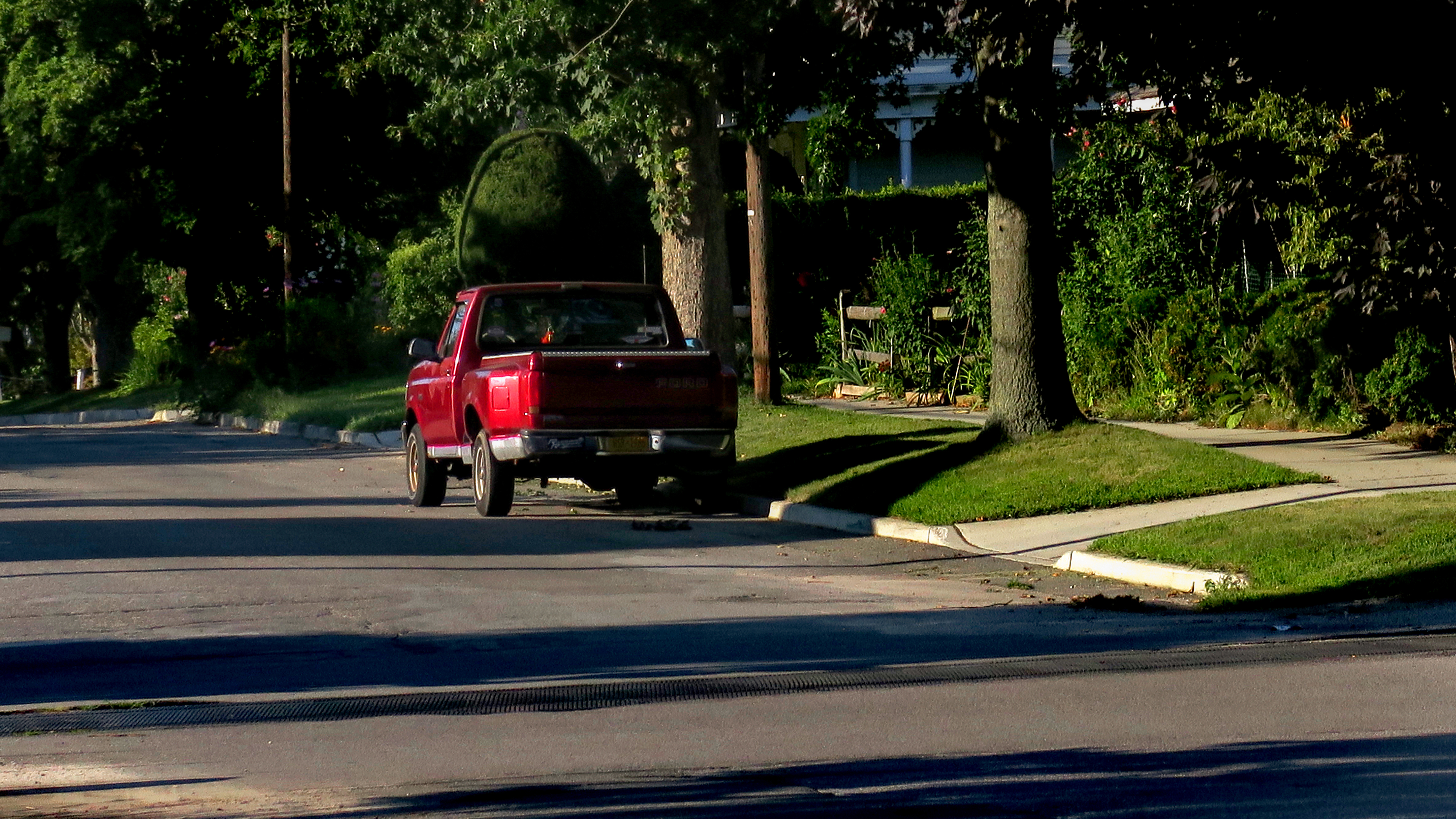
We start in August 1988. I was thirteen years old, living in Staten Island, riding my bike home from a friend’s house, when I spotted my father’s red pickup truck parked in front of Donna’s house. Donna was a donut finisher at our family’s donut shop, and for weeks, I had noticed my father being overly friendly with her. At the sight of the truck, the hot feeling slithered up my spine. My first instinct was anger because my father said he had to be at the donut shop all afternoon. With my moral compass stuck on perpetual rule-follower, I reacted quickly—without considering consequences. I pedaled until my calves burned, took the concrete steps to my house two at a time, and slammed the front door open so hard that the metal knob indented our wall.
“I saw Daddy’s truck in front of Donna’s house,” I blurted to my mother. My heart thumped in my ears, and I feared I’d lacerated something inside me.
I acted like a tattletale, but back then, I thought I was doing the right thing. I was Daddy’s girl from birth, and it was a rare moment that I aligned with my mother. I was furious—not because my father had lied to my mother, but because he had lied to me. I wasn’t policing their marriage; I was only seeing the world through the only lens I had mastered—my own.
I believed telling the truth had set everything in motion, and it took me decades to realize how much was already broken before I ever opened my mouth.
My mother was thirty-five years old, dressed in a velour sweat suit and imitation Birkenstocks she wore as house slippers. When she heard about the red truck, she bolted out the door and left me alone. I paced the vacuum tracks of our beige carpet, holding back vomit.
When my mother arrived at Donna’s apartment, she found the keys were still dangling in the door. Inside, she discovered my father engaged in an explicit, unnamed sexual act.
I can’t imagine what that walk back home was like, but when she emerged through our front door, she was a different person. Whatever she had been—a wife, a mother, a daughter, a sister, a friend, a computer consultant—when she returned, she was human pulp. She left her heart, her sanity, even her agency, on the other side of Donna’s door.
My mother collapsed onto our worn brown leather couches, and for hours she kept repeating, “No one should have to see what I saw.” She got up only to go to the kitchen to
refill her glass with vodka. Before that night, there had always been a splash of lime-green liqueur, so it could be called a melon ball, but that was the last of the colored drinks.
That night merged into years of couch-side babysitting her grief. My parents stayed married another decade, but the fissure never healed.
I can recall only one conversation I had with my father about the Donna incident. Maybe it was the day after or the following week—time became a sludge we plodded through. The dialogue is blurry, but I can still taste the sunny-side up eggs I ate while we spoke. I stared at my plate, avoiding his eyes. He was a Soviet-bred man of his generation, and the gist of what he said was this: “I am the father, and you are the daughter,” and he made it clear that he didn’t owe me an explanation.
A week later, I was hanging out, chatting with friends on our block, when my mother screamed my name from our front door, over and over, like a broken car alarm I couldn’t shut off.
She stood shaking in front of our door, wearing the same velour sweatsuit, her hair in a frizzy halo. Her face, originally full of makeup, looked melted.
“What’s wrong?” I asked, annoyed. I had barely left her side all week.
“Take this from me,” she said, extending her arm as if she were offering candy.
“Take what?” I asked, not reaching.
“These!” She insisted, her fist shaking. I opened my palm. She dropped razor blades into my hand, one at a time—boom, boom, boom.
“I tried to use them,” she said, as if it were my fault for leaving her alone with them. She lifted her sleeve to show me dozens of scratch marks, some bleeding superficially.
What training did I have, at thirteen, to help my mother, who caught her husband in an affair and now wanted to slit her wrists?
“But I didn’t go through with it,” my mother said, presenting this information like a dog waiting for a treat. “I didn’t do it because of you.”
When she turned around to go back inside, I about-faced, the razor blades clenched in my fists, and my mother eked out, “Where are you going? You can’t leave me alone. You need to make sure I don’t do it again.”
I turned my back on my friends, and I guess on myself. Immigrant children were not taught to make themselves a priority. In 1988, we were not reading magazine articles about the importance of self-care and the need to protect our mental health. I was a thirteen-year-old girl who loved her mom, adored her dad, and wanted to protect her little sister. I did whatever I thought I needed to do to keep everyone alive and together.
So it was back to the leather couches, where we sat for what seemed like endless nights—through the end of the summer, when I turned fourteen, and started high school, and through most of my adolescence until I left for college. I never invited friends over, because after work, my mother was a permanent fixture on that couch, an oversized drink in hand, with the TV blaring to a show she ignored, as she made dozens of phone calls, slurring words and cracking up at her own snide comments.
We rarely get out of childhood unscathed, but somewhere in all of this, no one ever stopped to ask whether it had been her job to protect me.
I grew up, went to college, built a life—marriage, children—and through it all, I called my mother on most days. I listened to her slurred words, her rants about the evil in the world, her warnings that eventually my husband will cheat on me and that my kids will desert me. She forced me into a savior role on the day of the razors, and she never let me escape.
Usually when I hung up the phone, my eyes were wet, my chest heaving. But the next day it was always, “Hi, Dotsya, kak dela?” How are you? Dotsya, the diminutive term of endearment for the word daughter. For decades, I ached for a 1980s sitcom mom like Maggie Seaver from Growing Pains or Elyse Keaton from Family Ties—a cheerleader, a safety net, someone with a warm voice and a perfumy smell. But we don’t choose the mothers we get. Instead, we work to become the mothers that we wanted for ourselves.
Whenever we discussed her drinking, she said, “But I can’t unsee it. Whenever I close my eyes, all I see is your father and Donna.” Vodka—it turns out— wasn’t the best memory eraser. It was just liquid razors.
My mother spun herself into a tornado with this logic, using it to justify her drinking, and eventually, the dissolution of her marriage. But even with time, maturity, and reflection, I was stuck in my own loop. I clung to the belief that it was my job to save her, to protect her, and to reassemble her body. Because even though it’s hard to love hard people, it’s harder not to love them.
She was sixty-seven years old when she died, and the older I get, the younger that sounds. She had fallen many times over the years—the time she broke a bunch of teeth, the time she broke a leg, the time she crashed her car into a lamppost. The final time, she slipped on ice and shattered her femur. Every day from the hospital, she cried to me on the phone, complaining about having to wear a diaper and about the bed sores, insisting they were killing her.
Truthfully, I was jaded by then. I was tired of carrying the burden of keeping her alive. Or, more accurately, I was tired of believing that I had the power to keep her alive.
After the surgery, an enlarged vein in her esophagus ruptured, and she vomited blood.
“There were chunks of my liver in it,” she told me. Later, the doctors assured me that livers don’t dislodge and come up in pieces. If she’d been home when this happened, she would have bled out within minutes.
She had been on dialysis for five years. It had been keeping her alive, but now, on top of liver failure and kidney failure, her veins had dried up, and her blood pressure was too low to continue. All they could do was insert a central line into the side of her neck and administer pain medication.
She cried constantly, “Is this a life? Is this a life?”
“You can stop dialysis if you want,” I told her. “You can say no.”
“I can?”
I nodded.
Later, the doctors and nurses in palliative care complimented me. You are a very good daughter, they said. Not all children let their parents go.
Easy for them to say. They wouldn’t have to live with the memory of my head nod—my permission for her to die.
Once she decided it was over, she was relieved, some would say elated. “I’m going dead,” she told people on the phone. “Enjoy your life. Love you, bye,” like she was narrating a birthday text.
I couldn’t remember a time she’d been more joyful. She didn’t act like a dying person. I asked the doctors if she was miraculously getting better. They looked at me with pity.
“No,” they said, “This is what death looks like.”
I regretted telling her to stop. I should have begged her to keep fighting. I should have, I should have, I should have. They say comparison is the thief of joy. I say it’s the should-haves.
And still, I secretly yearned to unload the rocks from my pockets.
But when she finally died, every breath I took felt like I was inhaling glass dust.
In her last week, we talked about her life—her memories, her regrets. I asked what name she wanted on the tombstone.
“Bella Nemirovsky,” she said—the name she had used for forty-eight of her sixty-seven years.
“Why not your maiden name?” I asked.
She said this was who she became when she married my father at nineteen. She asked to be buried near his house, in the same cemetery as his sister.
“You don’t want to be in Queens next to your parents?”
She shook her head. “I know your father will be the one to visit me the most.”
And of course, she was right.
He visits her every other week. He collects stones on his walks in the woods and on the beach and brings them back to lay on my mother’s grave.