By Linda Conlon Weber
The mechanics of burying a child are harsh. No one wants to believe something like this can happen, especially to them, and so people want to know why the child is dead—what happened? They want to know so they can avoid being me.
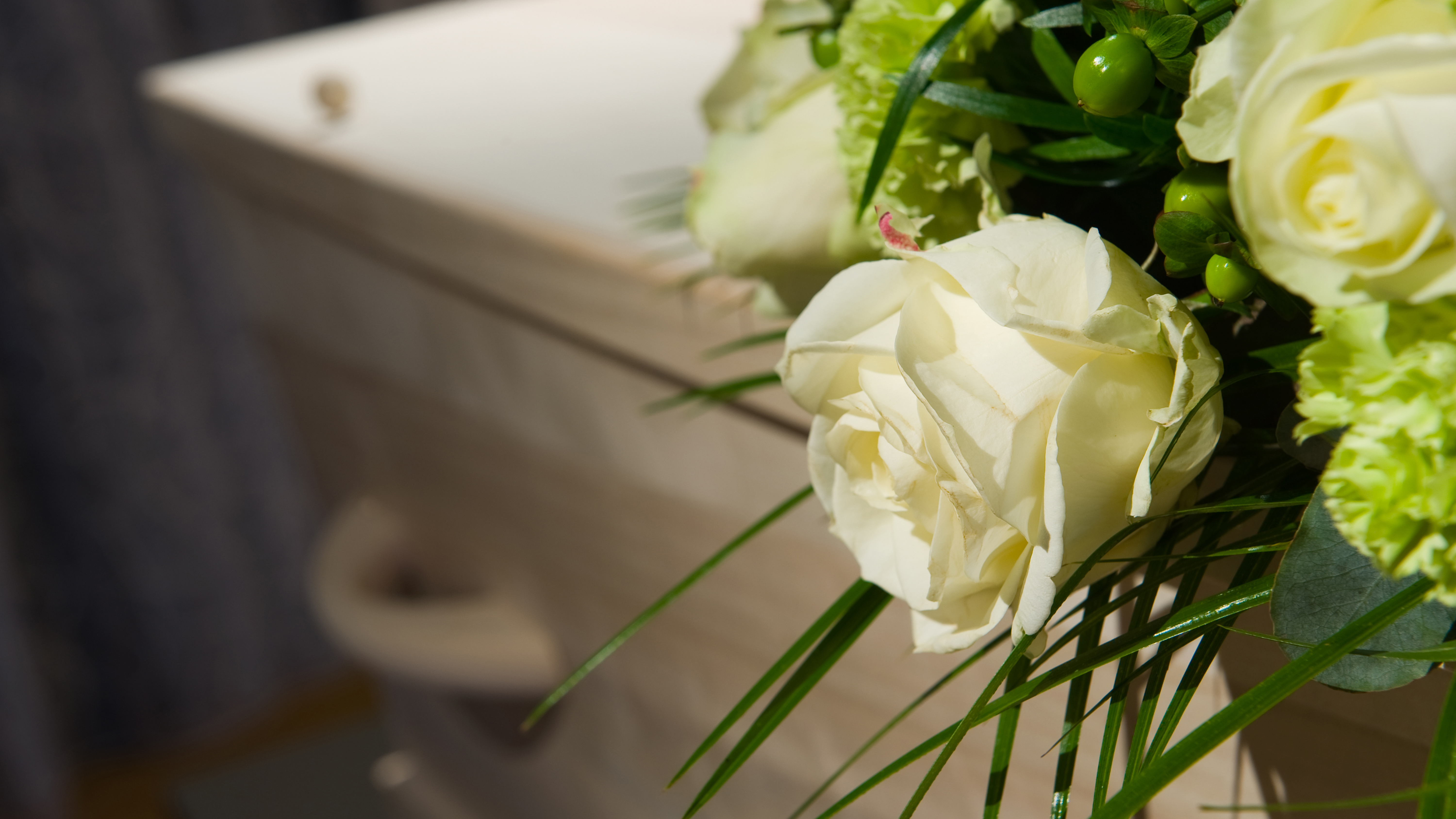
The funeral director knew not to ask. He had walked on this terrain. He folded his manicured fingers into a church-like steeple and leaning in he explained that there is only one style of a child’s coffin: small, white, and simple. I was grateful there were no decisions to be made about finishes or upgrades.
Even now, forty years later, it’s the questions—how did this happen, what did you do?—that still chafe and sear, and I am transported back.
The drive to the hospital was bumpy. We had discussed whether to do a straight shot down Second Avenue or take the FDR, which was a patchwork of uneven road repairs: comfort versus time. We chose time, which turned out to be the wise choice. A calm and gracious welcome at the admissions desk quickly turned into a flurry of machines and wires. A distressed fetal heartbeat dictated an emergency C-Section.
A C-section procedure typically takes forty-five minutes from start to finish; an emergency C-section will take fifteen minutes. It was more than two-and-a-half hours before I was taken to recovery. The staff was so shocked by what they saw that they called in a neonatal specialist. One nurse cried. My first born arrived with large, protruding eyeballs that were clouded in rings of white. Her orbs were so large, the eyelids could not cover them, and the umbilical cord lacked a second artery.
As I regained consciousness in the recovery room, I hear a fragment of a sentence coming from my left. “Tell her.” Another voice to my right says, “I will.” And now I am fully awake. “There is a problem,” the doctor says.
My heart is beating—thump, thump. Why is it so loud? I can’t hear the doctor. His mouth is moving silently. I disassociate from my body and like a bird I rise up above the bed and watch this triptych of fear below me. Strangely, I am not afraid. I stretch out my wings and swoop down into the journey awaiting me.
I will not have the normal experience of giving birth to a healthy child, where you hold this bundle of flesh and imagine a future of normalcy. Normalcy. What a strange word. I want that. I want normalcy.
I make my first trip to the ICU to see her. Her appearance has been described to me, but I am still shocked when I see her. Her head is a third the size of her body and her eyes are monstrously deformed. I have to look away. I focus on her fingers, and her toes, and her slender arms and legs, all exquisitely perfect and pink and lovely.
I wear a mask and gloves, and a very gentle nurse allows me to place my index finger into the incubator to touch her cheek. Love grows in the harshest environments. Mine takes root.
They fear her deformity is from an infection which is why I can’t touch her. That theory falls away quickly, and I am able to hold her. This is awkward; the pain of the C-section incision and the fragility of her body make it difficult to get close. I stop visitors from coming to see me because it is too hard to take care of their emotions; they come in with the enthusiasm of “it can’t be that bad,” and leave in shock once they see her. I never get used to those reactions; they will always sting.
A meeting is convened of the chiefs of ophthalmology from the area hospitals. There had been a conference call to discuss the case, and photos had been faxed to each, but they wanted to see this “presentation of symptoms” in person. They are flummoxed—that is the word the doctor used. Flummoxed means completely unable to understand. Flummoxed is not normal.
The chiefs of opthalmology refer us to an expert in Baltimore—a pediatric genetic ophthalmologist. The appointment is in six weeks. We are sent home from the hospital, and we try to do as the doctor says—be a normal family, caring for a newborn infant.
It’s a gorgeous November day. The air is crisp and the sky is a vibrant, cloudless blue. Yellow tinged leaves flit across the windshield of the taxicab. The universe feels so large and vast, and I feel the enormity of the responsibility to keep my non-normal child, who has flummoxed the city’s top doctors, alive.
All I have is this unrecognizable surge of love churning up from the pit of my stomach. I sense that this surge of fierce new love will now become my friend. I will do anything for this child.
I think of my parents and wonder if they felt this way about me, felt this primal urge to do whatever it takes to keep your child safe. And then, right there, in the span of a fifteen-minute taxicab ride, holding this bundle of brokenness, I forgive my parents for all the dumb and stupid insignificant things I blamed them for. They were doing the best they could with what they had. I become a parent.
Why?
Why? is the question everyone harbors in their mind—why did this happen? We had to search for the why did this happen? We must do that. We must know why this happened, so it doesn’t ever happen again. We must especially know the answer so other people can avoid what I did to make this happen, so this doesn’t happen to them. And this was always the most painful part—having to deal with what happened, what did you do?
What did I do?
A kindly geneticist broke it down for us in what sounded like storybook language. He said that every person in the world has bad genetic material that is quiet, silent. When two people with the same quiet, silent, bad genetic material get together, the resulting DNA has a twenty-five percent chance of being loud and seen. That’s what happened. Our baby got some loud, junky DNA.
But there was more. Loud, junky DNA likes company, the kindly geneticist explained. We should expect other genetic abnormalities to show up, which they did.
The first diagnosis was congenital Peters anomaly, a deformation of a small canal in each eye which happens at five weeks gestation and results in the eyes not forming correctly. Her presentation was severe and required double corneal transplants. The plan was to do the first corneal transplant over a Memorial Day weekend and the second over the July Fourth weekend. Statistically, it was known that there were more car accidents over these specific holidays involving families, thus the higher likelihood of harvesting a cornea from a younger cadaver. It wasn’t quite presented to us like that; the language they used was more opaque.
We checked into the hospital two days before each holiday and waited. The Memorial Day cornea was from a three-year-old girl who was run over by her grandfather backing his truck out of the driveway. The Fourth of July cornea came from a sixteen-year-old boy sneaking a joyride on his father’s motorcycle. I’ve read accounts, often inspiring and heartwarming, of organ recipients meeting the donor family and expressing gratitude or feeling a spiritual connection to the deceased. I felt none of that. I felt like a scavenger, waiting my turn for the universe to turn someone’s tragedy into my benefit. With the new corneas she could now react to bright light. It felt like a victory as she was fitted with dark, tinted glasses as she groped about her surroundings.
And this was the best season of her life, a period of nine months, when I reveled in her hard- fought gains. I became a scientist, observing cause and effect, postulating suppositions, correcting conclusions, collecting data, trying to imagine what her world was inside her skin. When you walked by her at a six-foot distance, not five or four, she reacted to the shadow. But she wouldn’t know it was me, until I got closer and she could feel me, and mostly, smell me. Scent was her superpower. I could throw her off by changing my shampoo. I created a “sensory tunnel”—a six-foot cardboard box from a refrigerator delivery. I glued the inside walls and floor with carpet remnants and swatches of textiles and hung bells, chimes, and tied bunches of dried herbs from the ceiling. We would crawl in, me lying down, her sitting, and she’d feel all around and she would find me.
The geneticist’s prediction unspooled by her second year. A diagnosis of type 1 diabetes added a grueling layer of care—thrice daily finger pricks and insulin injections. Another piece of DNA junk showed up with a diagnosis of celiac disease, requiring a special diet. And then, gradually, a realization that her developmental delay could no longer be solely attributed to her visual disability. Something else was going on—autism.
When you are a caregiver, you inhabit a different world. It is like living on an island just slightly offshore. You can see the mainland where life is normal, and you sometimes pop over to get a full night’s sleep, or have a meal in a restaurant, or laugh with some friends. But mostly, you live on “island time” that is defined by unbending routines, crushing obligations, and this pervasive hope that perhaps improvement is someday possible. So you can’t see decline. It takes someone coming to your island and saying to you, “Something doesn’t look right.” The last piece of junk was kidney disease.
Over the course of her four years, it never occurred to me that she would not live beyond childhood. I thought we would just always be that couple with the blind, diabetic, autistic child. Yes, there were moments of joy when she and I made fleeting connections and I felt known by her, but mostly her world was cut off from me. We were both stranded on that island.
The end came quietly in a child-size hospital bed, just before dawn, at the changing of the morning shift. I had always stayed overnight, by her bedside, during these hospitalizations, but this one time (yes, only once!) I acquiesced to the urgings of others to go home and get some rest.
Acquiesce: to accept reluctantly, without protest. That was me, acquiescent. I was sure that I should have stayed.
The yellow, wall-mounted dial-up phone in the kitchen rang just as we were walking out the door to go to the hospital, and it felt just like those scenes in a movie—you know who is calling and why. The doctor assured me that she had died peacefully, which I had decided over these years to mean she was not awake, feeling and smelling for where I was.
It took me some time to get over making the decision not to stay. When I would tell people that I wasn’t there, they would tell me not to feel badly and that this kind of thing happens all the time; patients wait until everyone leaves the room and then they quietly let go and slip away. But I did feel badly. I wanted to be there.
The funeral was held in the evening.
The minister had the idea of having the coffin remain in the church overnight after the service. Her small, white coffin, surrounded by candles, stood alone under the grand domed church ceiling. A group of church members, many I didn’t know, scheduled a vigil throughout the night. She wasn’t alone, after all.
That next morning, we arrived and assembled behind the coffin, walking quietly, as it was rolled down the center aisle and through the arched door to the waiting hearse. Before we had left the house, I threw up into the white ceramic toilet bowl. I flushed it twice. The swirl of the water was somehow soothing.
As we exited the church, the early morning sunlight was blazing, cutting a low angle in the sky. It was November and cold, the sky a vibrant, cloudless blue. The ushers lifted the coffin up over their heads and I saw a young couple with a stroller walking on the other side of the street. They stopped to watch as Erica was placed into the hearse.
There was a time, before I took up residence on that island, when I would have given absolutely anything to be that couple, with that baby; to have a normal life, be unflummoxed, be filled with certitude and a stranger to acquiescence.
But I was here, on my way to placing a white rose on my daughter’s coffin amid mounds of dirt, unknowingly carrying new life within me.