By Luisa M. Giulianetti
When our knives dulled, Dad took to sharpening. Not quick sweeps against a honing steel.
“That straightens the cutting edge, but doesn’t actually sharpen the blade,” he explained.
Instead, he approached the task with the same precision and ceremony he applied to polishing shoes or staking tomatoes. He aligned the knives—save the serrated one—on his work bench, carver to parer. Carefully held and dragged each blade at the proper angle against the whetstone until he achieved maximum sharpness, assuring that future cuts would be precise, definitive. Nothing left hanging.
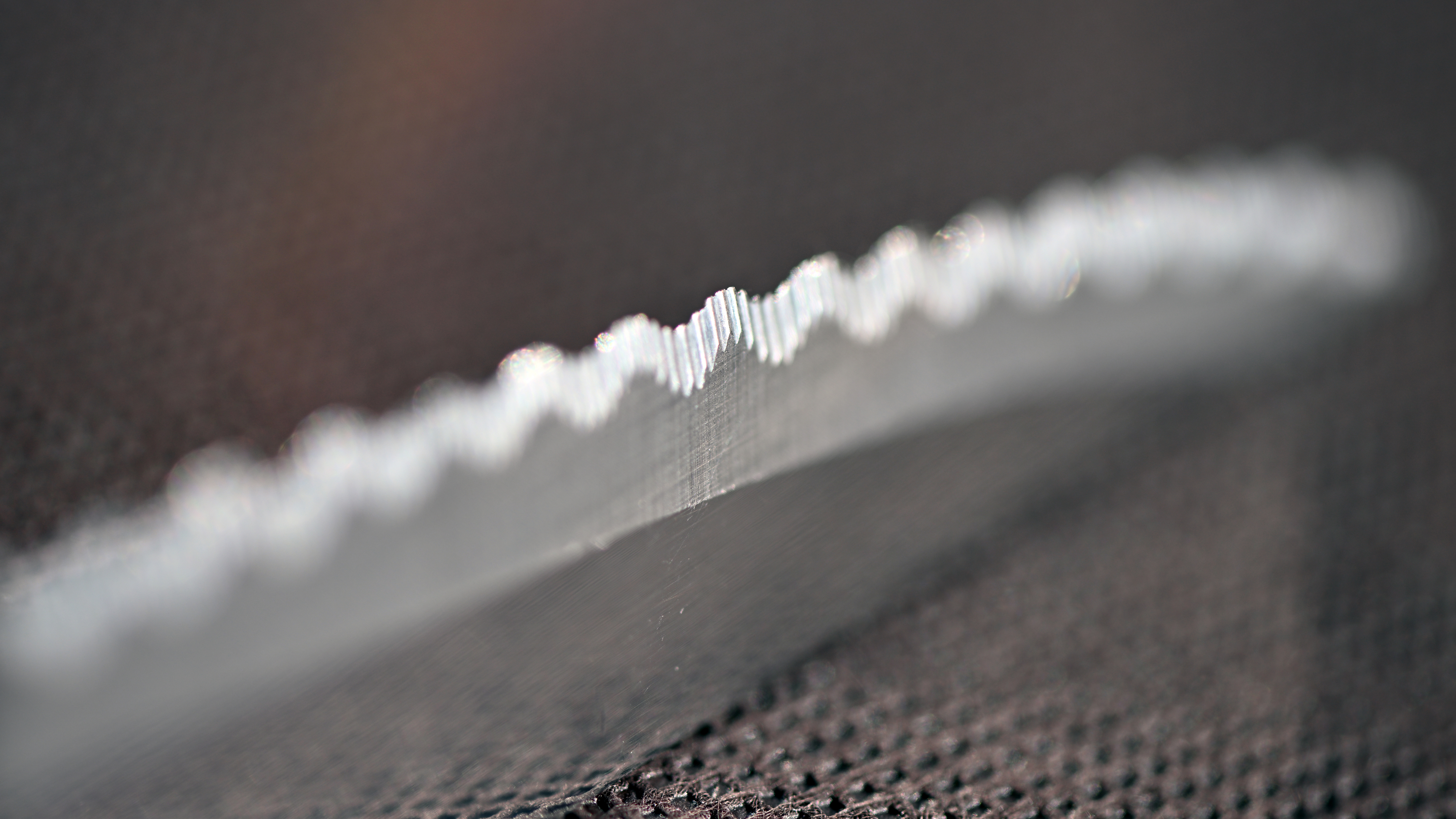
Serrated knives are sharp-toothed saws. While ideal for cutting bread and tomatoes, they mangle and shred other things. Leave deep, jagged wounds.
Among the more crushing aspects of Lewy body dementia is that people afflicted do not live out their days in blissful forgetfulness, in blithe ignorance. Instead, they remember what they lost, how they used to be. Cruelty, compounded. Serrated. Leaving countless wounds on the afflicted and their loved ones.
After dementia struck, Dad staggered through the world in perpetual uncertainty, from one technical difficulty to the next. Changing a roll of toilet paper or answering his cell phone became his personal Mount Everest. I repeatedly reminded him to press send and end, but he forgot.
“No Dad, you do not need to use your cell phone to call my cell phone. Use the home phone. It’s easier.”
“But I used to know how to use this damn phone.”
For forty-five years, Dad was an aeronautical engineer at NASA, part of a team that designed various aircraft—including the pioneering XV-15 Tilt Rotor. Co-authored a book about it. Yet, because of dementia, he could not change a battery, tie his shoes, balance his checkbook.
Dementia is a double death: both a slow-moving storm—one he and we watched approaching and gathering energy—and also a lightning bolt that stops a beating heart. Twin kicks of grief.
One minute, we were strolling on sunny Shattuck Avenue. The next, Dad was down on the pavement, bleeding, unable to get up, skin gashed on his cheek and arm, as if he had been on the losing end of a brawl. We righted him, got him into a nearby beauty shop where the kind owner cleaned his wounds the best she could.
“Why are we here,” he asked, “I want to go home.”
Those afflicted with Lewy body manifest signs of Parkinson’s disease: rigid muscles, halted movement, a shuffling walk. They are prone to falling.
*
One of my enduring childhood memories is spending Saturday mornings alongside Dad in his garden. His worn khakis neatly ironed, the linger of Marlboro Gold 100s blending with the grassy scent of tomato leaves. He’d pull his knife from his back pocket to cut sucker shoots, errant branches, twine to steady a stake supporting his legendary tomatoes—the talk of the town. He’d pick, cut, and core an apple: half for me, a half for him. We’d eat, as if death were nowhere near.
Technical issues were Dad’s bread and butter. There seemed nothing he couldn’t solve. Addressing a sloping side of the house, fixing a broken toy, digging a well in impenetrable clay soil, designing a novel aircraft that successfully operates as both a helicopter and a plane.
“You need to think about things logically,” he’d say. “Take your time. Draw it out.”
On yellow pads with his Property of the US Government mechanical pencils, he spent hours appraising, sketching, computing. Confident, uniform numbers and letters as if typeset. Then his logic corkscrewed, splintered. Pages filled with scratch marks and scribbles. Indecipherable, crabbed. Margins abandoned.
“How do I call you on my cell? In case I need you when your mom isn’t here?”
*
When my mom spied my dad’s swollen finger, hot and throbbing, three times its normal size, infection-like lava spreading across his hand, she asked, “What happened to you?”
Dad offered, “I don’t remember.”
Somewhere, after the emergency room—where the attending doctor said Dad was lucky; he was nearing septic shock—and before he spent the next week in the hospital, connected to an IV stream of antibiotics, Mom figured it out: Dad found a serrated knife in the garage and cut some errant branches from the bottom of the Christmas tree. Always the engineer, he liked things neat and symmetrical. Ordered. He cut his finger, forgot about the injury, didn’t mention or disinfect it. Claimed he didn’t feel it. Until he did. Contagion blazing. The surface wound was small, a peephole puncture, but it burrowed deep into layers of tissue. Bacteria colonized; pathogens entered his blood stream making a beeline for his already weakened organs. The sepsis symptoms he manifested—confusion, lightheadedness, shivering, erratic breathing—were usual for Dad, in the latter stages of Lewy body and went unchecked. Until it was almost too late.
“Do you see them,” my dad said, pointing to the empty couch.
“See what?” I asked.
“Those creatures. God, they’re ugly. Why are they here?”
If Dad had to hallucinate, I wished that his mind would invent agreeable figures: sweet-faced animals, soft-featured children, Tony Bennett. Instead, scary denizens followed him to appointments, hid behind store displays, made themselves at home on our furniture. He confused tree branches with people, believed his caregiver had designs on my mom. To an extent, the meds mitigated the delusions. Maybe our validations and distractions provided a level of comfort.
“It must be scary, Dad, to see those creatures. Let’s go check out the tomatoes.”
*
I inherited Dad’s prominent veins, his long toes (prehensile, he’d joke), fondness for puns and red wine. His inclination toward routine. We began each day the same way: slid into slippers aligned bedside, drank coffee, spent a few minutes outside in morning’s honest hours. The newspaper. Crossword puzzles. Temperaments set to habit and anticipatory worry.
“It’s not you I worry about, it’s the crazy drivers out there,” he’d often say. “What airplane are you flying on? Make sure it’s not a DC 10. They have serious design flaws.”
Grief smells like povidone-iodine, feels like a rubber ball rolling in my palm, which I squeeze gently every few seconds. I give blood because of my dad. For as long as I can remember, he visited the blood bank every two months. I have one of Dad’s champion blood-donor keychains, the one that held his keys and pocketknife. His last set. The one from which we removed the car key in case he tried to take to the road after his brain frayed and disease stole his autonomy. Clutching the metal ring, he pleaded with my mom, brother, and me that he was fine to drive: “just around the neighborhood,” he reasoned. “I won’t go far.” Sometimes, I’d find him in the driver’s seat of the parked Nissan, staring ahead.
*
Grief sits in my dad’s chair at the kitchen table of my childhood home, well before first light. Silence hangs heavy, relieved only by my mom’s shallow snores and the clock’s metronome. The previous evening, at the local library, I read from my newly published book. Read the poem I dedicated to Dad. I felt him—presence and absence—more acutely than usual. It’s been thirteen years, but my grief still feels newborn.
I half expect him to walk into the kitchen, slippers on, robe neatly tied over his pj’s, kiss me on the forehead, say, “good morning sweetie,” pour a cup of coffee, and head out back for his morning smoke and survey of the garden. “Off to the south 40,” he’d say.
At his chair at the kitchen table. Thin, hunched. Defeat descends his face like a shade.
No, Dad, I say. I don’t feel safe in the car when you drive. Yes, Dad, if it gets to that point, we won’t put you in a home. You’ll be here or with me. I promise.
We kept that promise.
*
Dementia often leads to dysphagia, difficulty swallowing, which leads to dehydration and weight loss. When food or drink enter the lungs rather than being swallowed properly, people develop chest infections, including aspiration pneumonia. As Dad did.
*
Our family gathered for the Super Bowl. In previous years, Dad would be in the thick of it, watching and commenting from his favorite easy chair. This year he was in a hospital bed upstairs. He had stopped eating, was barely drinking. We gave him sips of water, swabbed his lips. Before the game started, I sat with him and talked about this and that. Told him it was Super Bowl XLVI, a game as old as I am. Mentioned that local phenom, Tom Brady, was quarterbacking the mighty Pats against the Giants.
“It should be a decent game,” I said. We weren’t fans of either team. The Giants defeated our beloved 49ers in overtime during the NFC Championship Game a few weeks back and few miles away, at Candlestick Park, the spot where Dad took me to my first football game. “Our Niners will make it back one of these years,” I said optimistically. The Patriots were a lock among fans and pundits. Vegas oddsmakers considered them three-point favorites. I coated Dad’s lips with wine, wanting one of his last tastes to be something he loved. He smiled.
“So, who’s gonna win today, Dad?”
“The Giants,” he said, with a clarity I hadn’t heard in weeks. “The Giants.” The last words he spoke to me.
21-17. He was right.