By Hannah Paige
“I contain multitudes”—Walt Whitman
“I can only say, there we have been: but
I cannot say where.
And I cannot say, how long, for that is
to place it in time.” —T.S. Eliot
I am writing a eulogy for my brother. He’s not dead, but there was a time when I was young and far away from where I grew up and people would ask me if I had any siblings, and I would say “two.”
And then there was a time when I was young and still far away from where I grew up, and people would ask me if I had any siblings and I would say “one.”
And now, I am not as young and nearly no one asks me if I have any siblings, but if they did, I would tell them “no.” And I would think, but not say, “but there is a space within me that did not once exist. There is a vacancy blinking, blinking, blinking.”
I am open, but please knock before coming in. You may startle the bones, jostle the memories from their places, and I don’t want to pick up the glass when you shatter them.
I was not always this way.
There was a time when I thought myself infinite. You could call me a sister. You could call me an artist. You could call me a woman. You could call me little. You could call me a little sister.
Once, there was a man with a crooked jaw and blue eyes and a too-large nose and a shy demeanor and you could call him a man and you could call him a firefighter and you could call him a father and you could call him big and you could have called him a big brother.
Once, you could have called him a brother.
Once, you could have called me a sister.
There is no memorial arrangement for a multitude. You cannot print a funeral card for yourself. But there is a death. There are many nights when I think of how my son’s blue eyes are not only his father’s but also his uncle’s, who he has never met and maybe never will; there are nights when I light a candle for this brother and this sister that I used to be and I place the candle in the window and wait for someone to see it. To ask me who it is for. To give an empty, but well-meaning “I’m sorry.” Even to blow it out, to tell me “no open flames in summer months” because at least this would be an acknowledgment of what has passed. Who has passed.
But this death is just another intangible. This candle does not exist. But the window does. The window is made of the pennies we cast into the wells we couldn’t find, the pennies that stained our hands and smelled so strongly of sharp copper, sharp blood, that it saturated our skin. This window is made of this skin on our hands that we shared and we share, though we never touch this skin to skin, which is to say we have not held hands since we held pennies, which is to say that this window is cold.
I am writing a eulogy for my brother. He’s not dead, but when I call him, the line rings and rings and the sound echoes down a tunnel with no light at the end of it. I press the phone to my ear, and I can hear the emptiness, this not-there echoing back. I wait. I sweat.
I am writing a eulogy for my brother, though he will never read it. There was a time when he would have. There were once books with dog-eared pages in his room. There is a photo on my father’s phone of the two of us squished into the back seat of his truck with suicide doors and a back row so tight my brother’s long legs are collapsed. We each hold a book on our laps, our shoulders are touching and neither notice the camera. Once there was a time when he read my stories.
“I don’t understand them,” he said, “but they’re yours.”
This was enough.
Once, I had a brother whose words carried weight. Whose words gave me weight.
I inhale. Exhale. Write another page and use up ink that another sister or brother could have used. Un-read ink is as sad as an empty crib. Another life. Another multitude that is not so much erased but simply gone.
I am writing a eulogy for my brother because when I wrote a eulogy for my sister, she could not write me back. Maybe this one will be different. When I wrote a eulogy for my sister, there were white lilies in the room and my brother in the front row and my father crying and there were so many pages. I didn’t edit a single word out. It was early and raw and I was afraid that if I cried ink onto the page and then erased some of the words, it would be as if they’d never existed. I’d never existed. Another candle. Another window. I am nearly out of matches.
I am writing a eulogy for my brother because I can’t paint or draw or sing. But if I could, I would paint the treehouse that was not a treehouse, but a ladder I made out of spare planks of wood and nails and orange paint leftover from when my mother painted our living room bookshelves. I leaned it against the tree to help me climb onto the branch that my brother swung on easily. I would paint boys who pushed me into the wall after Sunday school whom my brother later scared. I would paint the inches between him and me; which is to say that I would paint space. I would compose a piece for a cello, or at least the lowest string of a violin. There is no room in this composition for E-strings, but there is room for sharps that tug at the ear. There is room for flats that slide into the back of the throat and root themselves. There is no room for staccatos, because our disintegration was not fast, nor was it short.
No death is this way.
This eulogy will not be short either, and I could apologize, but this would imply that someone is sitting in the audience listening to this composition. Someone is paying to see my orange ladder murals. The concert hall is empty. The art museum has no steps echoing inside it. These concerts are too abrasive, these pieces are too rambling, affrontive to the eye.
I am writing a eulogy for my brother’s nose. I am writing a eulogy for my brother’s laugh, his squinty eyes in photographs, the tears I have only seen him shed enough times to fill a medicine cup, and if you don’t know what I mean by this, it is the plastic measuring tool that is always immediately lost. Which is to also say that I am in multiple facets eulogizing an absence.
You must reach out. You must reach out. You must reach out. I was told to find him. I was told to find him. I was told—She was told, because it is a she now, not an I. I am not this sister. I am not this sister. She was told to touch this absence. Draw him into her arms and hold him there because what he is doing is hard, what he is feeling is broken. He is lonely. He is within his own absence.
I am writing a eulogy for my brother who is not dead, but who did hammer the nails into his own coffin. His fingers smell of sealant, beeswax on his shirt.
Because I did try to reach out to him. I did reach for him. I did hold his palm in mine and the sand stuck to my skin and when he let go, I stared at the horizon for so long that the sun scalded my eyes, then the sunset scalded my eyes and then the next sunrise scalded my eyes.
When my brother left, I picked up his beach towel. I shook the sand from it. I folded it three times and hung it over the bathroom door to freshen in the shower steam. I fed his dog. I watered his plants. I tricked this place that we had inhabited, that had held us together, into believing that he was still here. For a time. But then my eyes burned so badly that I couldn’t see if the plants were still alive. His dog stopped eating the food that I gave him, and I knew this was enough.
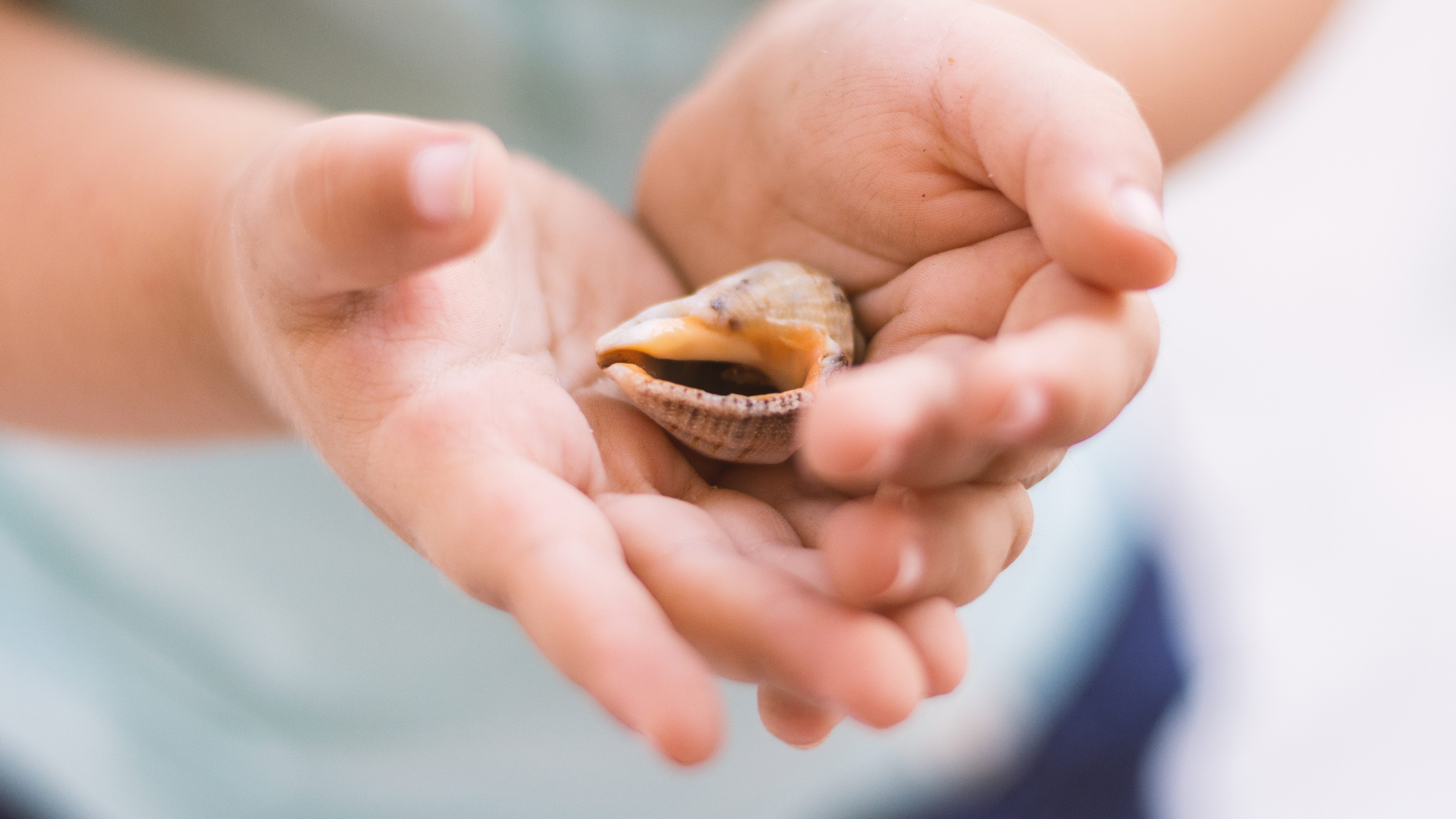
I am writing a eulogy for my brother, who shouted “I love you” into a shell and then handed it to me and called the sound permanent. I held the shell to my ear again, again, but after so long the promise became a whisper and then a lie and then a question and then just a shell.
I have burned down the house. I have killed the plants. I have ripped the composition and stabbed the mural and pinched his blue eyes within my memory until their juices ran cold in my fingers. I have crushed my phone. I have thrown the shell into the sea. I have mourned the multitude of a sister.
I am writing.
A eulogy.
For my brother.
Because.
I still tell my son that he has
His.
Uncle’s.
Blue eyes . . . . . . . . . . . . . . . . . . . . . .