By Edward Fowler
Ever since Hiroko died of cancer, here in the family room of our Irvine, California home, track lights in the ceiling remain lit through the night. The object of their illumination is a section of wall shelving dedicated to her memory. Upon retiring, I dim the lights and climb upstairs in the dark. This after paying my respects to her cremated remains. In a very literal sense, my dead wife occupies the room.
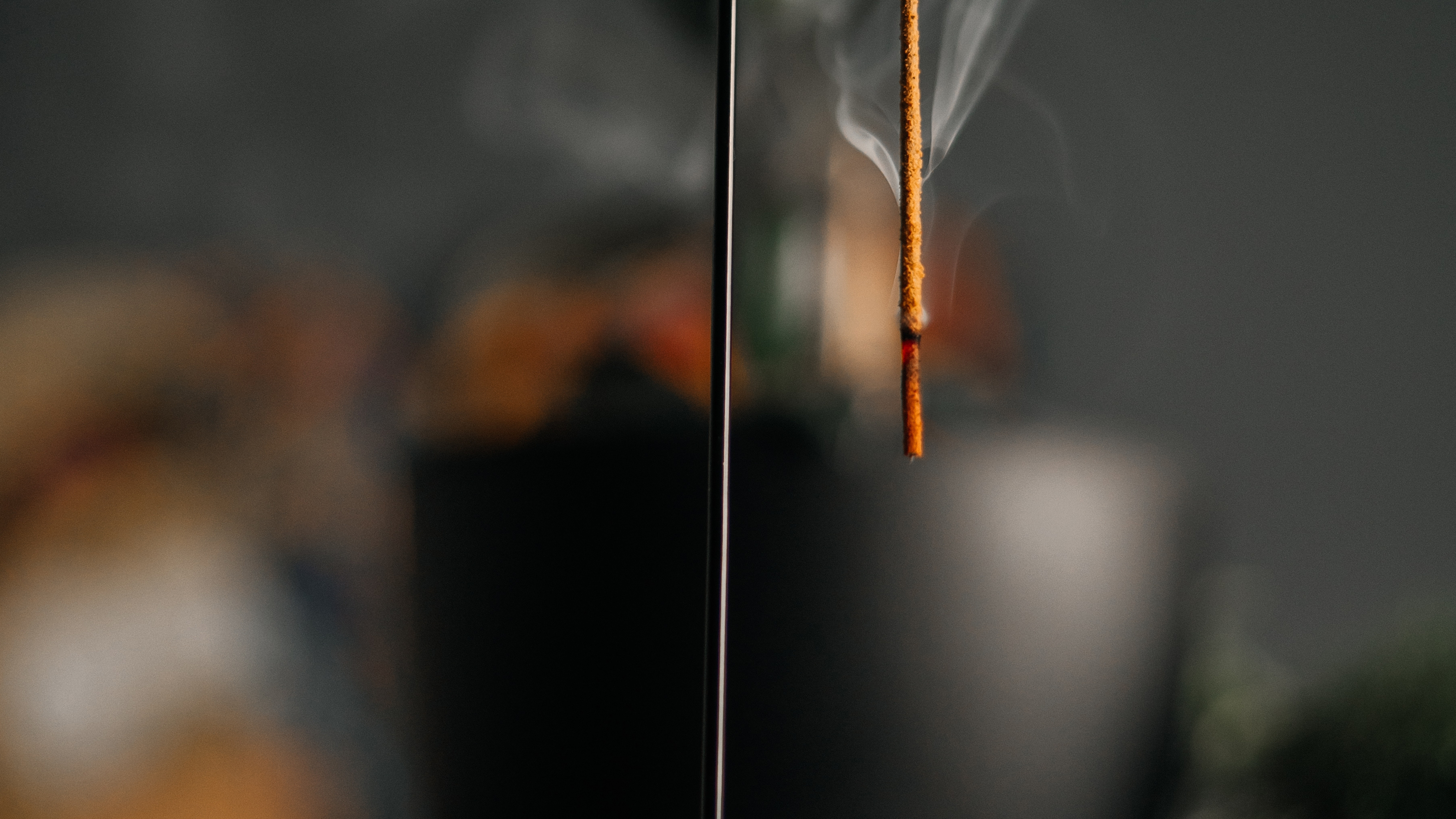
This same room is where every morning I conduct a simple Buddhist rite born of my many years in Japan. Facing the hardwood shelves, I first light a candle and with it a stick of sandalwood, then place the stick in a bronze vessel filled with ash. Using a cushioned clapper, I ring a bowl-shaped bell to the right of Hiroko’s framed image—a photo of her at her parents’ home in the Kyushu hinterlands, taken before she fell ill. The bell still ringing, I join my hands in prayer.
These implements—incense, candle, bell—can be found in most Japanese homes. They are generally placed before a lacquered cabinet, which is set on the floor and houses photos, memorial tablets, and other items honoring deceased family members. My own arrangement, sans cabinet, makes it easier to pay respects while facing the shelves standing up.
The bell, cast from high-grade brass and burnished to a soft sheen, is rather large for home use. When shopping for one with Hiroko’s mother in Japan, I was won over by its warm, reassuring sound. Overtones reverberate long after it is struck.
***
Some mornings, when I’m in a hurry, I give the brass bell a hasty clap and then be on my way. Today I have no appointments and can spend more time at my makeshift altar.
I take in everything: the bell and Hiroko’s image, the just-lit candle and incense, the lacquered tray holding fruit in season, flowers picked from the garden. Before the image, in their own small tray, is a pair of porcelain vessels. One holds water (sometimes tea); the other, rice. On the days I cook rice, I follow custom and offer some to the hotoke (spirit of the deceased). Not only is rice the staple in Japan, its nickname (shari, familiar to diners at a sushi bar) connotes the Buddha’s bones, said to have resembled crystalline rice grains after cremation.
True to a decades-old promise I’d made, although deviating from custom, I occasionally make an additional offering. Long before she fell ill, Hiroko insisted that she’d be the first to die and instructed me on offerings beyond the default of cooked rice.
“Please make a home altar like they do in Japan. And talk to me every day.”
“Sure. And I’ll offer cooked rice too.”
“Don’t forget to offer foods I like. Corn kernels, snow peas, sprouts. . . .”
Accommodating individual whims is not uncommon. Ruth Ozeki, in her story “Linked,” writes: “Inside the house was a small Buddhist altar with a candle and incense and a framed photograph of my grandfather, and every morning my grandmother used to make a cup of hot water and leave it next to his picture. When I asked her why she did this, she explained that he preferred it to tea.”
Ozeki’s words ring true. The dead impose on the living. Yet this is not a burden, for we the living are looking to find ways to personalize ritual.
And what better way to personalize it than by talking to the deceased? The home altar is the site for conveying news of the family, be it a proud moment or pressing concern. Scenes of characters reporting events of note to deceased family members are a staple on Japanese TV. Visitors to a Japanese home will see their gifts of food or drink being offered at the altar in acknowledgment of receipt by all in the house, including the dead.
I, too, talk to my wife, aloud and silently. Perhaps I’m just talking to myself, but that doesn’t bother me. An honest conversation of any sort is probably a good idea.
The upshot is, I conduct my daily observance not so much for devotional purposes as for the comfort I derive. It feels more instinctive than religious.
Still, I recall a passage from Joan Didion’s The Year of Magical Thinking: “Someone at the table raised a question about faith. The theologian [in attendance] spoke of ritual itself being a form of faith.” Reacting to this remark, Didion decries the failure of ritual to bring her dead husband back. My purpose, though, is not to resurrect my wife. It is to commune with her in her present state, housed in a wooden urn.
I was baptized by my maternal grandfather, an Anglican émigré, and confirmed in my thirteenth year, when I could recite pages of scripture by rote. I don’t think of myself as having abandoned that faith (though I admit, after Annie Dillard, to being “spiritually promiscuous”). But I have absorbed much of the Buddhist worldview as popularized in Japan.
I’m not referring to doctrine, such as the Three Gems (the Buddha, his teachings, the monastic community); the Four Noble Truths about our world of suffering and the means of transcending it; or the Eightfold Path of right conduct and thought, known as the Middle Way. I have in mind the tolerance I discern less often in churches than in temples—or in Shinto shrines, many of which stand on temple grounds despite the prewar government’s campaign to promote Shinto and degrade Buddhism. Few Japanese avoid a temple because they are devotees of a shrine, or a shrine because they patronize a temple. They pay their respects at both.
I have lived in Japan long enough (or simply a varied-enough existence) to appreciate the culture’s predilection for “both-and.” One set of beliefs needn’t cancel the other out. Granted, there are critics, even in Japan, who decry the sort of perspective that accommodates conflicting ideas. Yet such a perspective wisely acknowledges the anomalies in life. Rather than discard divergent ideas, many Japanese add them to their store of possibilities.
This fondness for “both-and” is one reason why Shinto and Buddhism coexist. It helps, of course, that they hold largely separate portfolios. Japanese generally observe Shinto rites for newborns and at weddings, Buddhist rites at funerals. Shinto funerals do exist, as do Buddhist weddings. But Japan’s indigenous religion focuses on the living, Buddhism on the dead.
Unlike neighboring Korea, Japan has not taken to Christianity, although church weddings (and their facsimiles in hotels and wedding centers) are common. Buddhist death rites prevail, yet adjustments can be made. Exercising the “both-and” principle, the wife of an acquaintance placed a crucifix in her husband’s casket at his temple funeral; he’d been baptized in childhood as a Catholic. “He was never sure if he was a Christian,” she told me, “but he did seem to feel it was a part of him. So I thought, why not? The casket had room for it.”
“We put our faith in things great and small,” Kay Redfield Jamison astutely writes in Nothing Was the Same, a memoir about her late husband. “We assign to them meaning they may actually have, or meaning that we need for them to have in order to carry on.”
Other than keepsakes specific to the person, every item on the family room shelves can be found gracing similarly dedicated spaces in Japanese homes, from nooks in kitchens or the tops of bedroom drawers to sitting-room alcoves housing ornate cabinets.
Every item, that is, except the urn. In Japan as a rule, cremated remains are stored at home temporarily in a ceramic jar before being interred in the family plot. Hiroko’s parents did so and expected me to do the same: transfer them from home to gravesite by the forty-ninth day after death, which in the Japanese Buddhist tradition marks a departed soul’s passage to the next world. I haven’t followed this practice, which may be the most important of all.
I don’t know if I ever will. I would deny that I obsess over Hiroko’s remains, but I confess to being at a loss where to bury them. My family has no grave plot. My parents arranged to have their “ashes” scattered on their property. I have yet to decide on my own resting place. Keeping Hiroko home has seemed the best way of dealing with contingencies. Owning a plot near my current residence could make life difficult were I to relocate. It did for Hiroko’s parents, who purchased a plot in the town where they lived but later moved away. My reluctance about burial was initially the cause of strain, but time has worked in my favor. So has the custom of portioning, which allows two or more parties to share a loved one’s remains.
***
Hiroko’s remains awaited final disposal after her funeral in California. She had been dead for three weeks. Her parents, Otōsan (“Father”) and Okaasan (“Mother”), planned to take their half with them for a burial service in Japan.
The day we had set aside for portioning was upon us. It was early January, cold and rainy as it had been all season. My son Eugene’s school outing that day reduced the evening meal to a threesome. The stress of awaiting his return manifested itself in the way Okaasan recalled Hiroko lobbying her parents to let her apply for a high school exchange program in the United States, then despairing over their refusal.
“What made her so dotty about America?” Okaasan spoke as if no answer would suffice. “She was infatuated with the country long before she ever met any Americans.”
Otōsan, merely nodding, prepared a buffer against Okaasan’s brooding monologue in the form of a shōchū cocktail.
“Oh, did she ever complain!” Okaasan didn’t wait for a reply. ”She had us in a tizzy, going on strike—that’s how she put it—pitching a tent and camping out in our garden. I can’t imagine what the neighbors thought.”
Okaasan didn’t mind that Otōsan wasn’t keeping up his end of the conversation.
“I wonder if it was in her blood. My parents lived for a decade in California. My two sisters were born here. That was before my time. I was never curious about their life in the US.”
Okaasan turned to me. “Hiroko’s favorite subject was English, but fondness for a subject doesn’t necessarily translate into brilliance.” She lowered her voice, as though Hiroko were in the next room. Which she was, albeit confined to the urn. “Her teacher said she just wasn’t ready. That left us having to tell her no.”
I’d heard a very different story from Hiroko, before we were married, about headstrong parents who denied her the very thing she wanted most. “It was the chance of a lifetime,” she told me when we were sitting in a back room of her parents’ home. I was a first-time visitor, asking for her hand in marriage and mindful of appearances. Hiroko, less mindful, was uncharacteristically dredging up the past. Slumped on the tatami, she jabbed her fingernails repeatedly into the mats. “They wouldn’t even let me apply, because they didn’t want their daughter doing anything their nieces didn’t do. After that, I knew I had to get away.”
Okaasan turned to her own marriage, which had begun inauspiciously. She was in her early twenties, of suitable age and attractive by all accounts. Her brother, who assumed responsibility for her welfare after their parents’ death, arranged to have her wed his former classmate, a frequent visitor, whom she thought tightfisted and dawdling.
“This classmate—I mean Otōsan here—approached my brother, who agreed to the arrangement without a word to me! I ran out of the house all the way to the elementary school grounds. But all I could do there was curse my fate.”
Taking advantage of my presence in displaying her ancient displeasure, she spoke as if Otōsan, who nursed his drink and emitted an occasional chuckle, were a disinterested party, not the target of her lament.
“There wasn’t a thing to like about the man, but my brother couldn’t turn his friend down. That was the sad reality. Women weren’t allowed to choose.”
***
When Eugene returned from his outing, the four of us went about our work as though we’d rehearsed it in advance. Kneeling in the family room, we placed the urn on newspapers spread over the rug. We lifted the brass receptacle out of its container and unscrewed it at the corners, each of us working a screw in turn. We removed the double-plastic bag holding Hiroko’s remains, then placed her engagement ring and wedding band, stored in a separate bag, in the shallow, felt-lined tray in the urn’s upper compartment, where her hospital bracelet already lay. I held the plastic bag over a sturdy paper sack, which Otōsan would take to Japan.
Okaasan collapsed over the urn as I tipped the bag. Otōsan wept audibly. Eugene jabbed the screwdriver into the rug. I’d had my cry already that day but still fought back tears.
“Keep pouring!” Otōsan commanded, eyeing sack and bag. He grabbed the bag and began pouring by himself. Eugene snatched the bag back and held it to his chest.
His grandparents marveled at the sand-like grains, which, they agreed, looked more like ashes than bones. How different from Japan, they said, where cremated remains resembled nothing other than the bones they actually were. This I knew from having taken part in several cremations. Working in pairs face-to-face and using unmatched chopsticks, we transferred the remains, still warm in the metal pan, from pair to pair to a plain, porcelain jar. We started with the foot bones and worked our way up to the cranium. The crematorium director made sure we placed one particular neckbone, the second cervical vertebra, atop the other bones (the placement and quantity of remains vary according to local custom). The Japanese call this neckbone the “Buddha in the throat” (nodobotoke), a term also used to designate the cartilaginous Adam’s apple, which of course doesn’t survive the fire. The bone’s triangular shape is said to resemble a monk sitting cross-legged as when meditating.
No, Otōsan and Okaasan told me, these remains couldn’t possibly be handled with chopsticks. They were much better suited to scattering.
Our task complete, Eugene re-screwed the receptacle. “It’s all right, Dad,” he said, ignoring his grandparents. “Mommy’s always with us. She loved us the most.”
He pulled out Miracle on 34th Street, the video movie he’d bought with his own money in token celebration of Christmas. The English-language film appealed only to us. Eugene sat in one chair and motioned me to the other, effectively monopolizing the room. I saw what was afoot but let him have his way. Otōsan and Okaasan excused themselves and made their way upstairs.